
 Vedhathiri
Author
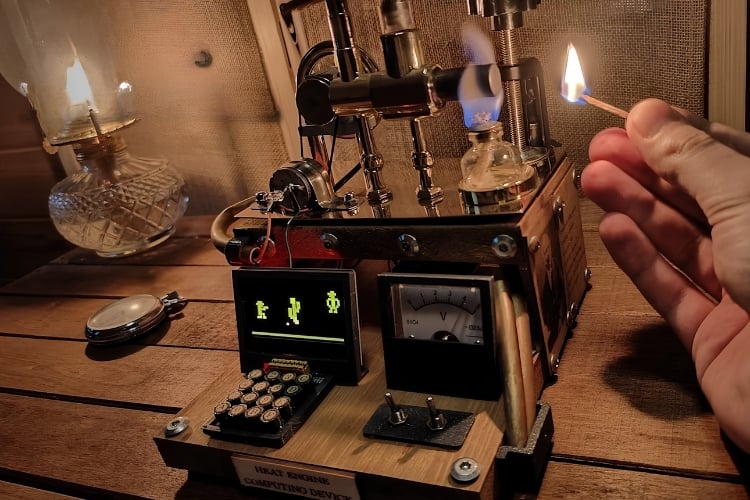
A maker from the Youtube channel PickentCode has built a working steampunk computer powered entirely by a Stirling engine, combining a 19th-century mechanical invention with modern electronics and retro computing. The Stirling engine was developed by Robert Stirling in 1816 as an alternative to the high-pressure steam engines of the time. Unlike a conventional internal-combustion engine, it does not burn fuel inside the cylinder. Instead, it operates using external heat and the expansion and contraction of a fixed quantity of gas. In this build, an ethanol spirit lamp heats one side of the engine while the other side remains relatively cool. As the enclosed air moves between the hot and cold regions, it repeatedly expands and contracts, creating pressure changes that drive the power piston. A displacer piston controls where the air is heated and cooled, while the flywheel maintains the engine's momentum and keeps the cycle moving. This thermodynamic process converts a temperature difference into mechanical motion, which can then be used to generate electricity. However, much of the ethanol's chemical energy is ultimately lost as heat rather than becoming useful electrical power, making the setup far less efficient than conventional power sources.
The maker uses that mechanical system as the starting point for a modern programmable computer. The build features an ESP32-C3 microcontroller, a 16-key keypad and a 2.42-inch monochrome OLED display, along with an analog voltmeter to monitor the engine's electrical output. The electronics are mounted inside a custom wooden enclosure designed with a Victorian-era steampunk appearance. The creator also repurposed an old shower tube to conceal wiring and used a laser-equipped pin plotter to engrave an image of Robert Stirling and his original engine design onto the wooden panels. To turn the compact electronics into an actual computer rather than simply a microcontroller display, the creator implemented CHIP-8, a lightweight virtual machine created in the 1970s. Its simple architecture, 16-key input system and low-resolution monochrome graphics make it well suited to the ESP32-C3 and the small OLED screen. This is where the project becomes more than a decorative experiment: the challenge is to show that even the relatively small amount of electrical power produced by a compact heat engine can be put to practical use in an extremely low-power computing system.
The completed machine can run CHIP-8 games and custom programs, with the maker even added a basic code editor for entering raw opcodes directly into the computer. In the final demonstration, the Stirling engine is started using the ethanol burner, the computer is switched on, and a custom program is entered and executed on the OLED display. The project brings together technologies separated by more than a century: Stirling's 1816 heat engine, 1970s CHIP-8 computing, a modern ESP32 microcontroller, 3D-printed components and laser fabrication. It is not intended to replace batteries or conventional power supplies the energy losses involved make those options far more practical but that is not really the point. The project demonstrates how a tiny heat engine can be combined with ultra-low-power electronics to create a genuinely programmable machine, turning a centuries-old engineering concept into a working piece of modern technology.