

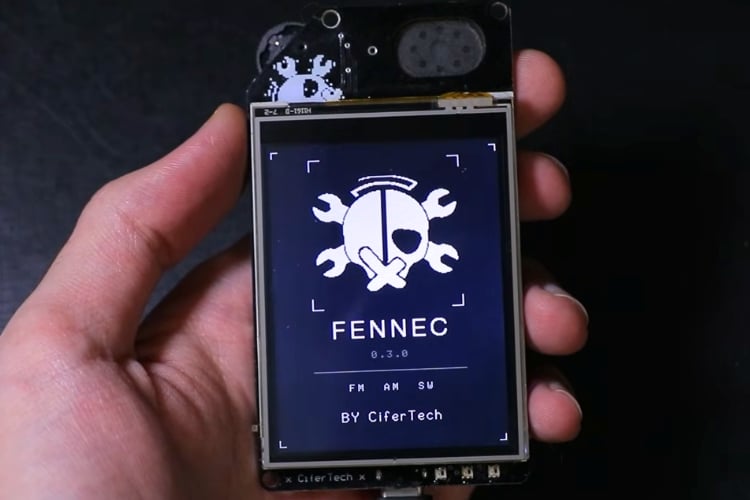
A small open-source handheld radio called Fennec is turning the ESP32-S3 into much more than a conventional AM/FM receiver. Built around the Silicon Labs SI4732-A10 radio receiver, Fennec can tune FM, AM and shortwave frequencies, decode Slow Scan Television (SSTV) images, translate Morse code into text, monitor radio activity and even help users locate a stronger signal by following its received signal strength. The project combines an ESP32-S3, SI4732-A10, 2.8-inch ILI9341 touchscreen, XPT2046 touch controller, audio amplifier, microphone and rechargeable battery into a portable radio listening station. Unlike a traditional radio that simply converts an incoming signal into sound, Fennec uses the ESP32-S3 to process the received data and add digital features around the radio hardware. Its receiver covers FM from 64–108 MHz and AM/shortwave from 153 kHz to 27.90 MHz, although it is receive-only and does not cover airband, NOAA, VHF/UHF or frequencies above 28 MHz.
One of Fennec's most interesting features is its ability to decode information hidden inside radio audio. With SSTV, an image is converted into a sequence of audio tones before being transmitted over radio. Fennec listens to those tones through the SI4732 or its onboard microphone, identifies supported SSTV formats such as Martin, Scottie and Robot 36, and reconstructs the image on its touchscreen. The device can also process CW Morse signals, using a Goertzel-based detection method to identify the tone and turn the dots and dashes into readable text. Another feature called Homing uses the receiver's RSSI measurement rather than a compass: as the user moves an antenna around, Fennec plots signal strength so the antenna can be steered toward a stronger signal. Its Watch mode takes this idea further by monitoring a selected frequency and recording events whenever a carrier remains above a configured threshold, making it possible to observe radio activity over time.
The project becomes even more interesting because the entire system is designed as an open hardware and software project. Fennec's GitHub repository provides its firmware, PCB files, schematic, precompiled firmware and detailed documentation, with the project released under the MIT license. The ESP32-S3 communicates with the SI4732 over I²C while handling the touchscreen interface, decoding functions and Wi-Fi web interface; users can connect a phone to Fennec's own Wi-Fi network and control the same radio remotely from a browser. This combination makes Fennec less like a simple DIY radio and more like a compact shortwave signal exploration tool: one receiver provides the radio input, while the ESP32-S3 turns that signal into images, decoded text, signal-strength information and activity logs. The project is also still evolving, with the roadmap mentioning additions such as an SD card, audio jack and a future transmitter, although those are planned features rather than capabilities of the current version.

Add a comment
No account needed. Your comment appears once a moderator has reviewed it.