

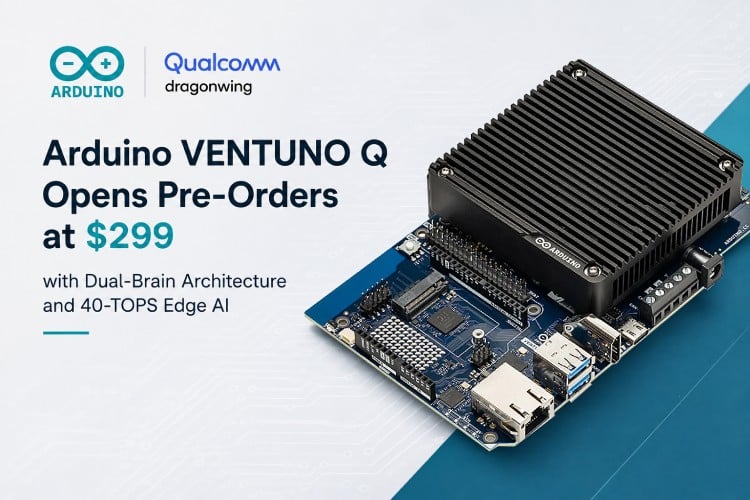
Arduino has opened pre-orders for the VENTUNO Q, a new edge-AI development platform built around Qualcomm’s Dragonwing IQ8 processor. The board is aimed at developers building robotics, computer vision, industrial automation and other systems where AI needs to interact with the physical world. According to Ankit Singh, Arduino’s India lead, the introductory pricing will remain in place for two months, with no limit on the number of boards that can be pre-ordered during this period. The board also comes with a 65W USB-C power supply as part of the introductory offer. Arduino currently lists the VENTUNO Q for pre-order, with deliveries expected to begin in around four weeks.
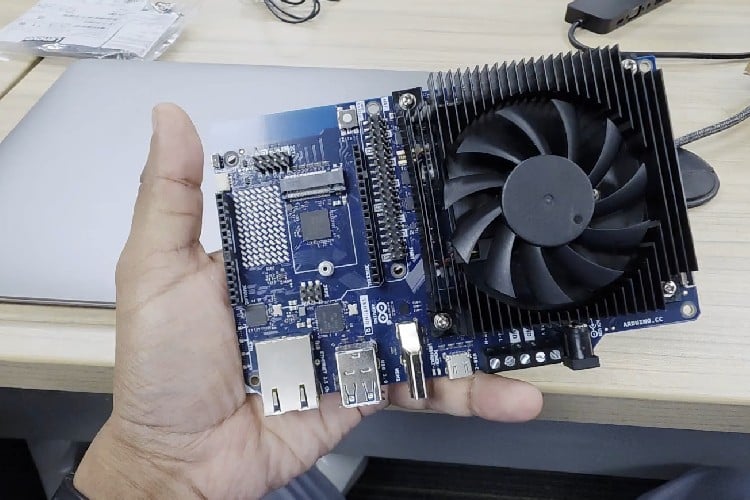
The key feature of the VENTUNO Q is its dual-brain architecture. The Qualcomm Dragonwing IQ-8275 handles Linux, graphics and demanding AI workloads, while an STM32H5F5 microcontroller takes care of real-time operations. The Qualcomm processor combines eight Kryo CPU cores with an Adreno GPU and a Hexagon AI processor capable of up to 40 dense TOPS. The Cortex-M33-based STM32H5, meanwhile, is designed for tasks that require predictable timing, including sensor handling, motor control, PWM, GPIO and CAN-FD. This division allows the Linux side to focus on high-level processing and decision-making without taking the real-time control responsibilities away from the microcontroller. The AI capabilities go beyond running individual machine-learning models. VENTUNO Q is designed for local inference of large language models (LLMs), vision-language models (VLMs), speech models and computer-vision workloads, along with multimodal and agentic AI applications. Through Arduino App Lab, developers can access ready-to-use models, bring models from sources such as Hugging Face and Qualcomm AI Hub, or train their own models using Edge Impulse. The platform also supports model cascading, allowing multiple models to work together as part of a larger application. For example, a vision model could analyse a camera feed, pass the result to a language or reasoning model, and then trigger an action based on the combined result. This opens the door to applications where an AI system can perceive its surroundings, understand what is happening and decide what to do next.
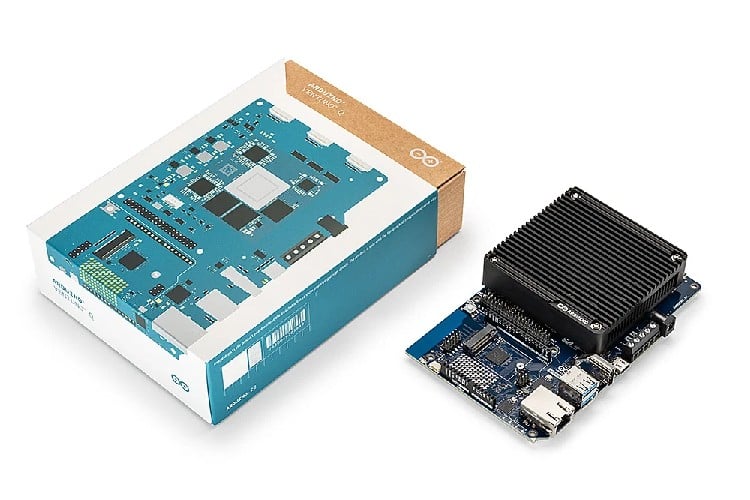
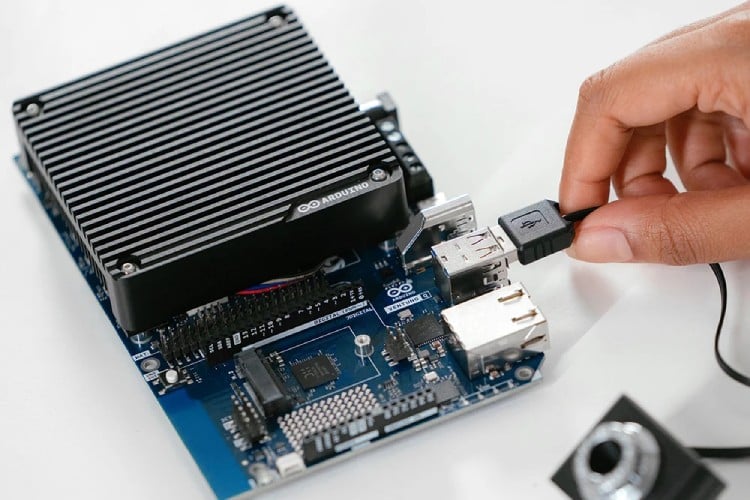
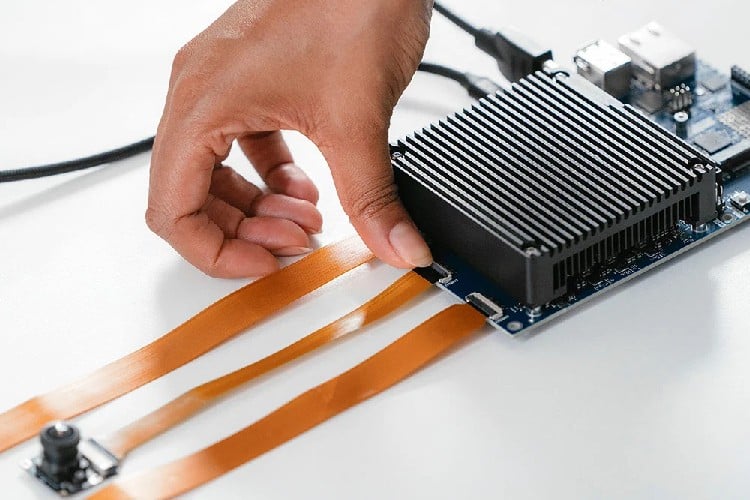
The hardware has also been built around these workloads. The board includes 16GB of LPDDR5 memory and 64GB of eMMC storage, with an M.2 slot for NVMe storage expansion. Networking options include 2.5Gb Ethernet, Wi-Fi 6 and Bluetooth 5.3, while display and peripheral connectivity includes USB 3.x, HDMI, DisplayPort over USB-C and MIPI interfaces. Three MIPI-CSI camera connections make the board suitable for multi-camera vision applications, while multiple CAN-FD interfaces and Arduino-compatible headers provide options for connecting it to vehicles, robots, industrial equipment and other hardware. Support for ROS 2 also makes it relevant to developers working on robotics applications such as perception, navigation and SLAM.
On the software side, VENTUNO Q currently supports Ubuntu and Debian, with Ubuntu pre-installed on the board. The current software configuration uses the Linux 6.18 LTS kernel, giving developers a relatively familiar Linux environment for applications and AI development. Qualcomm is also preparing support for its own Linux distribution based on the Yocto Project. According to Dmitry Maslov, Staff Developer Engineer at Qualcomm, support for the Qualcomm Linux distribution is expected to come to VENTUNO Q soon. The addition should be particularly relevant to embedded developers who need a more customised and controlled Linux environment for product development. Arduino App Lab provides a common environment for working across the two processors, but developers are not restricted to Arduino's tools. The Qualcomm side can be developed using conventional Linux workflows, including Python, C++, VS Code, Docker and other native tools, while the STM32H5 can be programmed using Arduino Core running on Zephyr RTOS. This gives developers the option of keeping high-level AI and application logic on Linux while using the microcontroller for the parts of a project where timing and predictable hardware response are more important.
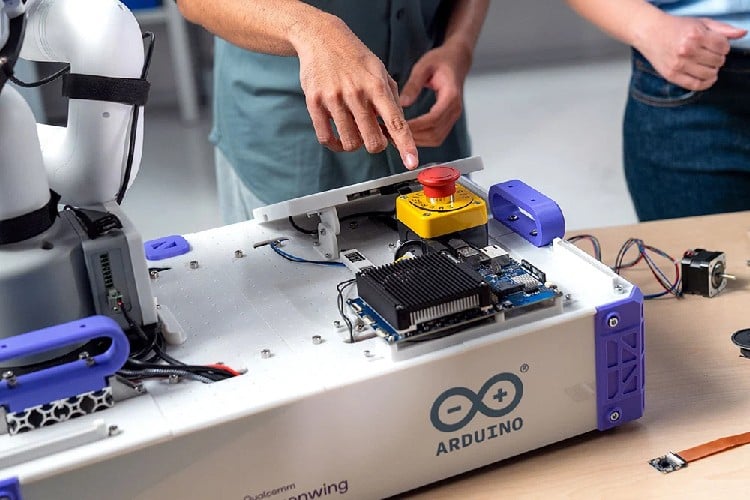
This combination is central to Arduino's broader physical-AI approach. A robot, for example, could use cameras and local AI models to identify objects or understand its environment, use a VLM or LLM to interpret a higher-level task, and then hand the resulting commands to the STM32H5 for immediate motor or actuator control. Since much of this processing can happen on the device, applications can reduce their dependence on cloud connectivity and avoid sending every sensor input or camera frame to a remote server. That can be useful where response time, connectivity, privacy or reliability are important. The VENTUNO Q also has a path beyond development and prototyping. Under the Works with Arduino program, SECO and Toradex are among the companies working with Arduino and Qualcomm on production-grade system-on-module solutions based on the same Dragonwing IQ8 architecture. The aim is to give developers a route from an initial VENTUNO Q prototype toward a commercial product while retaining the software, AI models and application logic developed during the early stages. For engineering teams, this could make the platform more attractive for projects that need to move from experimentation into larger-scale deployment.
With pre-orders now open, Arduino is positioning the VENTUNO Q as more than a high-performance Linux development board. Its combination of local multimodal AI, LLM and VLM support, substantial memory, high-speed connectivity and a dedicated real-time microcontroller is aimed at a new class of systems that can both understand their environment and respond to it. The introductory offer will remain available for two months, giving developers an opportunity to get started with Arduino's new Qualcomm-based physical-AI platform before the standard pricing takes over.

Add a comment
No account needed. Your comment appears once a moderator has reviewed it.