

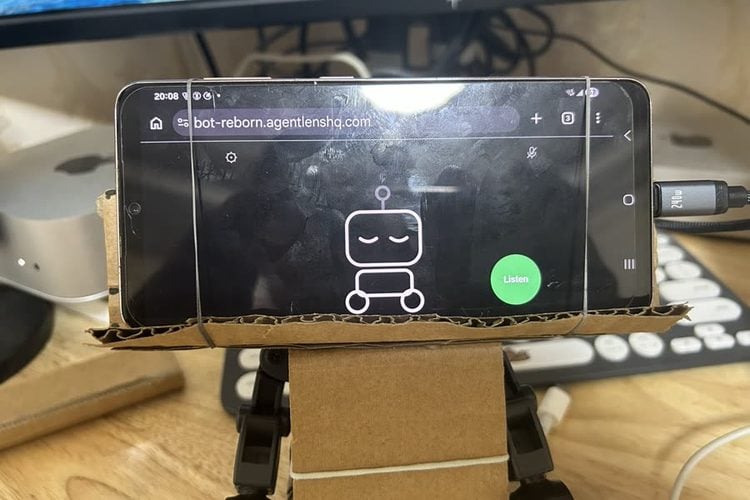
Talking robots usually have a lag problem: by the time a large language model has decided what "stop" means, the robot has already hit the wall. Maker Asten (beasaltfish) ran into exactly this while turning a $4 toy robot into a voice-controlled AI companion for their kid, and fixed it with a second, much smaller model. A fine-tuned 0.8-billion-parameter "reflex" model hears every command first and turns simple moves into actions in about 200 ms, and only hands the rest to the slower chat model. The whole project, called Bot Reborn, is open source.
Four wires to take over a toy
The robot is a Silverlit Maze Breaker, a line-following toy bought on the Chinese marketplace app Xianyu for 29.87 yuan, about $4. Inside, a single motor drives the tracks and a small electromagnet swings an armature left or right to steer. Two driver chips handle these, each with two inputs, so four wires control the whole car.
Asten cut the PCB trace between the toy's epoxy-blob controller and the motor driver, then soldered four wires to the driver inputs and connected them to an FT232H USB-to-GPIO board. An Android phone, held on top with cardboard and two rubber bands, drives the FT232H over WebUSB in Chrome. The phone is the robot's body: its screen is the face, and its microphone and speaker handle the conversation. The build log warns that the steering wires must go to the driver chip's inputs, never straight to the coil, or the FT232H pin will burn out.
A small model for reflexes
The "brain" is a small Node.js server on a computer on the same Wi-Fi, which handles speech-to-text, the chat model and text-to-speech. To fix the latency problem, a Qwen3.5-0.8B model fine-tuned with Unsloth reads every transcribed line first and picks one of a few actions: forward, backward, left, right, stop, keep going, or pass to the chat model. Because it returns a probability rather than generating text, it answers in about 200 ms on a Mac mini M4.
It was trained on 490 examples in about 30 minutes on a free Google Colab GPU and scores 86.6% (142 of 164) on its test set. In practice it behaves better than that number suggests, because a move only fires when its confidence is above 0.8. Anything less certain goes to the chat model, which is slower but will not send the car lurching off. As the build log puts it, getting a reflex wrong is worse than getting it late.
Key details
- Toy: Silverlit Maze Breaker, about $4, one drive motor plus an electromagnet for steering
- Interface: FT232H breakout on four driver inputs, driven over WebUSB from Chrome on Android
- Reflex model: fine-tuned Qwen3.5-0.8B, about 200 ms per command on a Mac mini M4, 86.6% on its test set
- Extras: several characters with their own names and voices, a "bark" mode, a stop button, and an admin page in English or Chinese
- Next version: an ESP32-S3 body with an INMP441 microphone and MAX98357A amplifier, already talking over Wi-Fi on a breadboard, because the phone is heavy enough to tip the car over when it reverses
- Code, dataset and model: Bot Reborn on GitHub (MIT), with the training data and model on Hugging Face
Our take
The two-model idea is the real lesson here, and it applies to any robot that takes voice commands: let a tiny, fast classifier handle the moves that must be instant, and only wake the big model when the request needs thinking. Asten also explains that the robot was built so their kid learns to talk things through with AI, asking and pushing back, rather than just photographing a problem for an answer.
Image credit: beasaltfish (Bot Reborn on GitHub), cropped and resized.
About the author: Aswinth Raj is an electronics engineer and the editor of CircuitDigest, where he has published more than 150 hands-on projects and tutorials across Arduino, PIC, ESP32, Raspberry Pi and EV battery systems. He selects the stories on this page for what engineers and makers can actually learn or build from. Connect on LinkedIn

Add a comment
No account needed. Your comment appears once a moderator has reviewed it.