
NAND
|
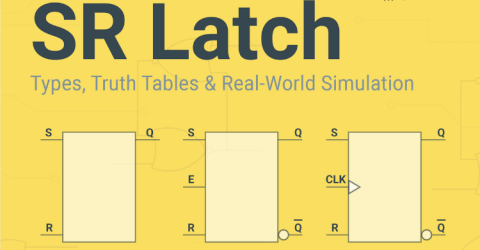
Understanding SR Latches: Complete Guide to Set-Reset Latch, Gated & Clocked Versions An SR latch is a basic memory element in digital electronics that stores binary data using Set and Reset inputs. This tutorial covers the SR latch truth table, the circuit diagram, and the working principle of basic, gated, and clocked SR latch variants. Initially, after the introduction of transistors, engineers constructed simple latch circuits using transistors. After several… |
|
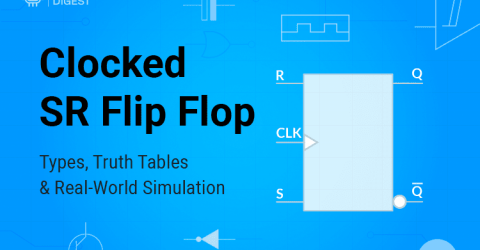
Clocked SR Flip Flop: Complete Guide with Circuit, Truth Table, and Working The Clocked SR flip flop is one of the most fundamental sequential logic circuits in digital electronics. Unlike basic SR latches, a clocked SR flip flop circuit uses a clock signal to control when state changes occur, making it essential for synchronous digital systems. This comprehensive guide covers the clocked SR flip flop truth table, circuit diagrams using both… |

|
Flip-Flop in Digital Electronics: Types, Truth Table, Logic Circuit and Practical Demonstration A flip-flop in digital electronics is formally defined as "A bistable device with synchronous inputs that changes state only at specified transitions of a clock signal" (IEEE Standard 91/1984) In general, flip-flops are fundamental components in digital electronics, capable of functioning as 1-bit memory storage devices. Unlike… |

|
Revolutionizing Memory Technology: Sanjeev Aggarwal, CEO of Everspin Technologies Shares Insights on MRAM's Role in the Modern Era Everspin Technologies has a rich history that dates back to 1996 when it was part of Motorola’s Magnetoresistive Random Access Memory (MRAM) group. Selected by DARPA for its mission-critical technology initiative, Everspin's roots were firmly grounded in the defense sector. Following Motorola's spin-off of its semiconductor business in 2004, Everspin continued its… |
|
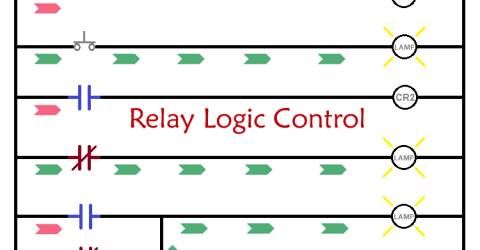
Introduction to Relay Logic Control - Symbols, Working and Examples Relay logic control systems are truly a foundation of industrial automation, and electromagnetic relays are necessary to perform switching actions in these conversion systems. The relay logic circuits also utilise relays along with switches, motors, timers, actuators, and contactors to form ON/OFF control systems effectively. Though relay logic control proves to be effective… |

|
D Type Flip-Flop: Circuit, Truth Table and Working The term digital in electronics represents the data generation, processing or storing in the form of two states. The two states can be represented as HIGH or LOW, positive or non-positive, set or reset which is ultimately binary. The high is 1 and low is 0 and hence the digital technology is expressed as series of 0’s and 1’s. An example is 011010 in which each term… |
|
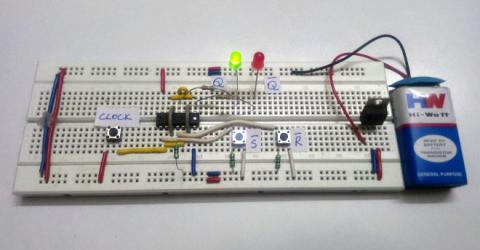
SR Flip-Flop with NAND Gates: Circuit, Truth Table and Working The SR flip flop using NAND gate truth table is a basic sequential logic circuit that holds one bit of digital information. This extensive guide goes over the general SR flip flop circuit diagram with explanation, a discussion of the truth table, and its implementation using IC SN74HC00N. If you want to become proficient in digital electronics and sequential circuit design, it's important to… |
|
NAND Gate NAND gate is a digital logic gate, designed for arithmetic and logical operations, every electronic student must have studied this gate is his/her career. This gate is mainly used in applications where there is a need for mathematical calculations. So calculators, computers and many digital applications use this gate. … |
