
arduino

|
DIY Arduino Wireless Programming Shield using Bluetooth Module While doing projects using Arduino, we always need to connect Arduino to PC in order to upload the program in it. But sometimes it is very uncomfortable to always connect the board with PC as if it is a robotics project then you always have to move the robot near to labtop to re-program it. This problem can be solved by programming the Arduino wirelessly. So here we are… |
|
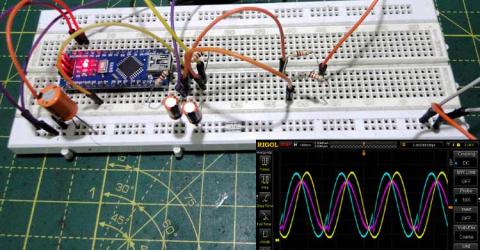
How to build an Analog Mixer - Additive Mixer and Multiplicative Mixer A mixer is a special type of electronic circuit that combines two signals (periodically repeating waveforms). Mixers find a lot of use in audio and RF systems and rarely used as simple analog ‘computers’. There are two types of Analog Audio Mixers - Additive Mixers and Multiplicative Mixers. 1. Additive Mixers Like their name suggests, additive mixers simply add… |

|
Sending Sensor Data to Android Phone using Arduino and NRF24L01 over Bluetooth (BLE) Bluetooth Low Energy (BLE) is a version of Bluetooth and it is present as a smaller, highly optimized version of the classic Bluetooth. It is also known as Smart Bluetooth. The BLE was designed keeping in mind the lowest possible power consumption specifically for low cost, low bandwidth, low power and low complexity. ESP32 has inbuilt BLE capabilities but for other… |

|
Arduino Sleep Modes and How to use them to Save the Power Power consumption is a critical issue for a device running continuously for a long time without being turned off. So to overcome this problem, almost every controller comes with an Arduino sleep mode, which helps developers to design electronic gadgets for optimal power consumption. Sleep mode puts the device in power-saving mode by turning off the unused module. Whether you… |

|
Controlling NEMA 17 Stepper Motor with Arduino and A4988 Stepper Driver Module A stepper motor is a type of DC motor that works in discrete steps and is used everywhere from a surveillance camera to sophisticated robots and machines. NEMA 17 stepper motor provide accurate control and can be differentiated based on torque, steps per revolution, and input voltage. In our previous project, we controlled a 28-BYJ48 stepper motor using Arduino. 28-… |

|
How to control a Solenoid Valve with Arduino Solenoids are very commonly used actuators in many process automation systems. There are many types of solenoid, for instance, there are solenoid valves which can be used to open or close water or gas pipelines and there are solenoid plungers which are used to produce linear motion. One very common application of solenoid that most of us would have come across is the… |
|
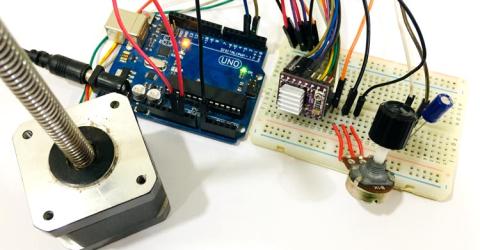
Control a NEMA 17 Stepper Motor with Arduino and DRV8825 A stepper motor is a type of DC motor that works in discrete steps and used everywhere from a surveillance camera to sophisticated robots and machines. NEMA 17 stepper motor has a step angle of 1.8° that means it will take 200 steps for a 360° rotation. By changing the rate of the control signal applied, we can easily control the motor speed. Stepper motor can be… |

|
Measure Sound/Noise Level in dB with Microphone and Arduino Noise pollution has really started to gain importance due to high population density. A normal human ear could hear sound levels from 0dB to 140dB in which sound levels from 120dB to 140dB are considered to be noise. Loudness or sound levels are commonly measured in decibel(dB), we have some instruments which could measure the sound signals in dB but these meters are… |

|
Arduino Controlled Musical Fountain using Sound Sensor There are several water fountains which unconditionally sprinkle water with some interesting lighting effects. So I wandered about designing an innovative water fountain which can respond to external music and sprinkle water depending on the music beats. Isn’t it sound interesting? The basic idea of this Arduino Water Fountain is to take an input… |

|
Chirp announces first integration of data-over-sound for Arduino boards Chirp and Arduino announced the first official integration of data-over-sound on Arduino’s range of boards. The integration allows Arduino-powered projects to send and receive data wirelessly through soundwaves alone, using just microphones and loudspeakers.
The partnership between Chirp and Arduino aims to… |

|
Interfacing a PCF8591 ADC/DAC Module with Arduino Analog to digital conversion is a very important task in embedded electronics, as most of the sensors provide output as analog values and to feed them into microcontroller which only understand binary values, we have to convert them into Digital values. So to be able to process the analog data, microcontrollers need Analog to Digital Converter. … |
|
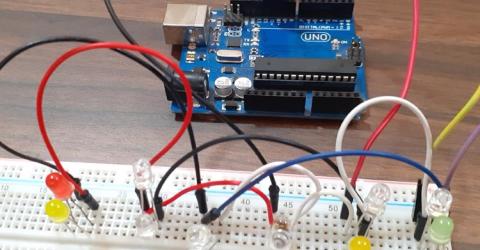
Charlieplexing Arduino - Controlling 12 LEDs with 4 GPIO Pins Charlieplexing is a technique of controlling many LEDs using a few I/O pins. Charlieplexing is same as multiplexing, but it uses the tri-state logic (high, low input) to reduce the number of pins dramatically and to gain efficiency over multiplexing. The Charlieplexing technique is named after its inventor, Charlie Allen, who invented the technique in 1995. We previously… |