

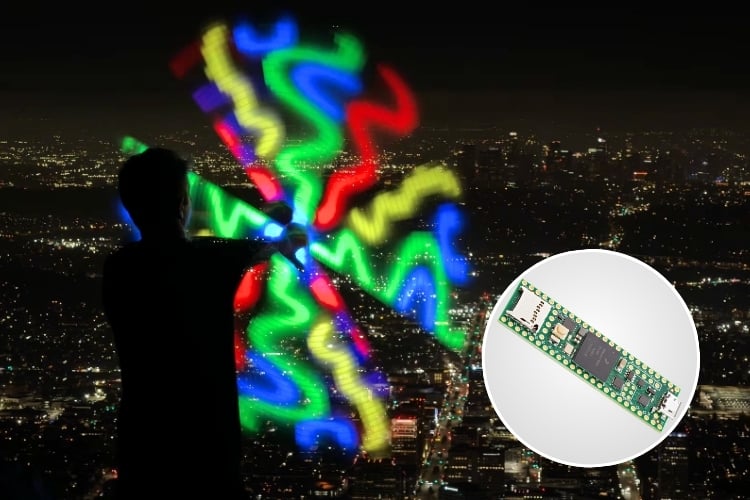
YouTuber Zachary McCune from Corridor Crew has turned a simple fire spinning hobby into an ambitious engineering project that can create images in the air while spinning. The project uses the principle of persistence of vision (POV), where rapidly changing lights appear to form a continuous image when moved quickly through space. Instead of using a conventional screen, the device displays an image one vertical slice at a time. As it rotates, the LEDs show different slices at precise moments, and the viewer's eyes combine those flashes into a complete picture. The final build uses APA102 addressable LED strips because their fast data handling and dense LED arrangement can provide the speed and resolution needed for the effect. A Teensy 4.1 acts as the main controller, handling the LED data, image processing and real time timing. The project started with simpler addressable LEDs and a basic prototype before moving to the faster APA102 strips needed for a more detailed display.
The biggest technical challenge was not turning the LEDs on but synchronizing the image with the rotation. The system uses an IMU or Inertial Measurement Unit to detect movement and help determine when the next vertical section of an image should be displayed. If the LEDs change according to a fixed timer while the person spins at a different speed, the picture can drift, stretch or rotate. During early testing, the creator encountered exactly this problem, so he temporarily removed the motion sensing system and played the image slices at controlled speeds to prove that the basic POV effect worked. The final electronics also include an ESP32, which works as a wireless interface so settings and firmware can be changed from a phone without taking the device apart. A Teensy 4.1 SD card is used for storing display data and patterns, while custom designs can be created separately. In the video, patterns were designed in Procreate before being used by the device. The power system uses two separate 3S battery packs made from 18650 cells, with one pack positioned at each end to keep the rotating device balanced. Each battery system uses a 3S BMS for protection and cell balancing, while 5V buck converters step the battery voltage down to the 5V required by the LEDs.
The mechanical design was built to survive the impacts that come with spinning and dropping a large electronic device. A 12 mm carbon fiber tube forms the central structural spine, while a polycarbonate tube protects the LED assembly. The creator also 3D printed components using TPU, a flexible and impact resistant material, for LED mounting, spacers and protective parts. The battery packs are mounted externally in removable protective housings, combining harder protection with flexible TPU cushioning. During development, the project went through several real engineering failures, including a cracked polycarbonate tube, power problems and two damaged BMS boards, before the final assembly came together. Once completed, the device could display colorful patterns and most importantly paint recognizable images in the air while spinning. The project combines POV display technology, APA102 LEDs, a Teensy 4.1, IMU motion tracking, ESP32 wireless control, SD card storage, lithium ion batteries, BMS protection, buck converters and 3D printed mechanical parts into one unusual display that turns moving light into a programmable screen.

Add a comment
No account needed. Your comment appears once a moderator has reviewed it.