

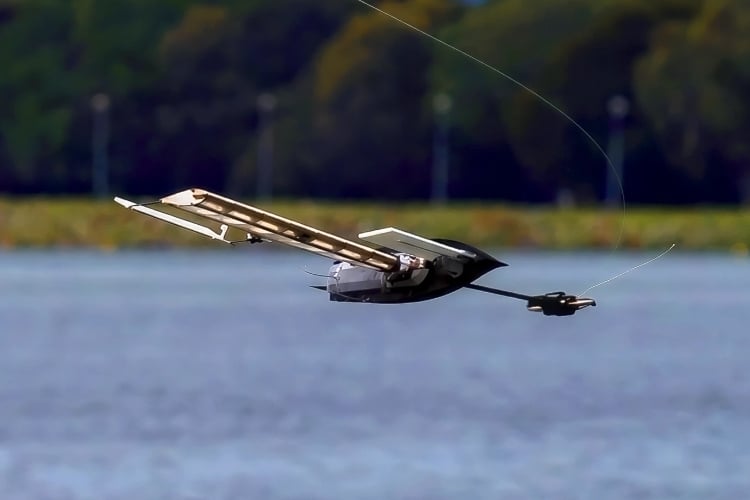
Researchers at the Singapore University of Technology and Design (SUTD) have developed ALBATROSS, a robot that can descend from the air, land on water, and then sail using wind power. Its name stands for Airborne Lander with Buoyant AuToROtating Sailing Sensor. The robot is designed to carry sensors to remote lakes, reservoirs, and other water bodies that are difficult to reach by boat. When released from the air, its rigid wings begin to rotate like a falling maple seed. This motion, called autorotation, slows the robot's descent and helps control its landing. Once it reaches the water, its floating body and low centre of gravity help it turn upright without human assistance. The research team demonstrated the smaller version descending from a height of 150 metres, landing on water, and righting itself.
What makes ALBATROSS different is that its wings serve as both rotating blades during descent and sails after landing. This design removes the need for a separate parachute or a powered flight system on the robot itself. On the water, the wings capture wind to move the platform, while a fish-tail-inspired rudder helps it steer and provides extra thrust when the wind is weak. The larger version uses a Teensy 4.1 microcontroller running C++ control software, along with navigation sensors and three actuators for sailing and manoeuvring. It can follow programmed GPS waypoints, including by sailing in a zigzag pattern to make progress against the wind. During testing, the larger version reached a peak sailing speed of nearly 1 km/h, with an average power draw of 3.98 W in the reported sailing experiment. It also completed an autonomous sensing run lasting around three hours, collecting environmental measurements such as humidity and heat flux.
ALBATROSS could help researchers collect environmental data from places where sending a boat is difficult or costly. However, it remains a research prototype, and its performance in open seas with strong winds, waves, and currents still needs to be tested. The team also explored reinforcement learning, a type of artificial intelligence that learns through trial and error, to control the sailing system. However, this approach did not perform better than the standard rule-based controller. To help other researchers build on the work, the team has published mechanical CAD files, C++ firmware, Python learning scripts, simulation models, and experimental data online.ALBATROSS shows how one carefully designed structure can help a robot move through two very different environments: air and water.

Add a comment
No account needed. Your comment appears once a moderator has reviewed it.