

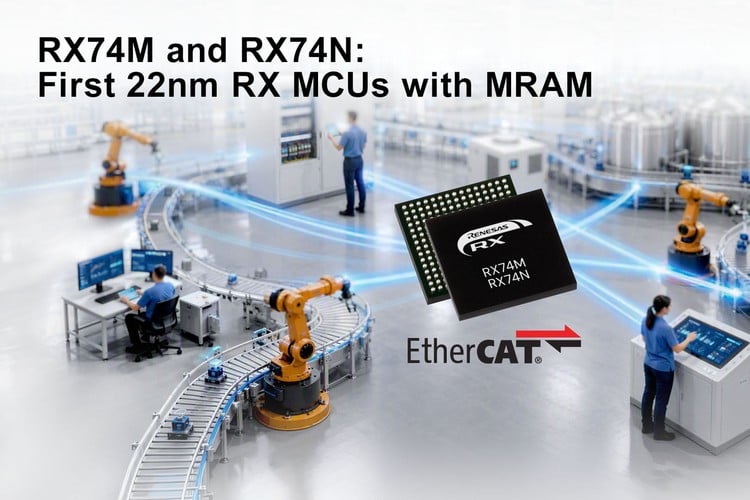
Renesas has launched the RX74M and RX74N, the first RX-family microcontrollers built on a 22nm process and the first to use embedded MRAM instead of conventional flash. Both run an RXv3e core at up to 600 MHz, and Renesas says they deliver more than twice the performance of the 240 MHz RX72M and RX72N they succeed. The RX74M targets factory automation gear like AC drives, industrial robots and PLCs, while the RX74N is aimed at smart meters, power conditioners and HVAC systems.
What is inside
| Feature | RX74M / RX74N |
|---|---|
| Core | RXv3e, up to 600 MHz (300 MHz parts also offered, with over 20% lower power) |
| Code/data memory | 1 MB embedded MRAM |
| RAM | 256 KB zero-wait-state TCM plus 1.5 MB SRAM |
| Networking (RX74M) | EtherCAT slave controller, TSN-capable Gigabit Ethernet switch, CAN FD |
| Security | ProtectZone secure/non-secure separation, new Renesas Secure IP (RSIP) |
| External memory | Execute-in-place from Octa flash with on-the-fly decryption |
| Supply / temperature | 1.62 V to 3.6 V, -40°C to +125°C (Tj) |
| Packages | 176/224/320-pin LFBGA, 100/144/176-pin LFQFP |
Why MRAM is the interesting part
Flash has to be erased in blocks before it can be rewritten, which is slow and is why firmware updates and frequent parameter or log writes eat into uptime. MRAM stores bits magnetically and can be written without a prior erase. Renesas pitches this as faster code and data updates, shorter programming times and less downtime, which matters in equipment that saves settings and logs often or gets field updates. The large zero-wait TCM is there for the other side of industrial control: keeping interrupt-heavy, branchy real-time loops fast and low-jitter at 600 MHz.
On the RX74M, putting an EtherCAT slave, a TSN switch and CAN FD on one die means a drive or PLC can speak EtherCAT, PROFINET or EtherNet/IP (including DLR ring redundancy, which earlier RX parts did not support) without a second networking chip. On security, Renesas positions ProtectZone and RSIP for the EU Cyber Resilience Act and says the hardware leaves room for post-quantum cryptography.
Our take
For engineers already on RX72M/N, this is the obvious upgrade path, with more than double the speed and the same FSP software package shared across RX, RA and RZ. Zephyr RTOS is listed among the supported real-time OSes alongside eForce, which is welcome for teams moving away from vendor-only stacks. Note that this is an industrial part, not a hobby board. Renesas says the chips and evaluation boards are available now, but it did not give prices in the announcement.
Image credit: Renesas Electronics, press photo, cropped and resized.
About the author: Aswinth Raj is an electronics engineer and the editor of CircuitDigest, where he has published more than 150 hands-on projects and tutorials across Arduino, PIC, ESP32, Raspberry Pi and EV battery systems. He selects the stories on this page for what engineers and makers can actually learn or build from. Connect on LinkedIn

Add a comment
No account needed. Your comment appears once a moderator has reviewed it.