

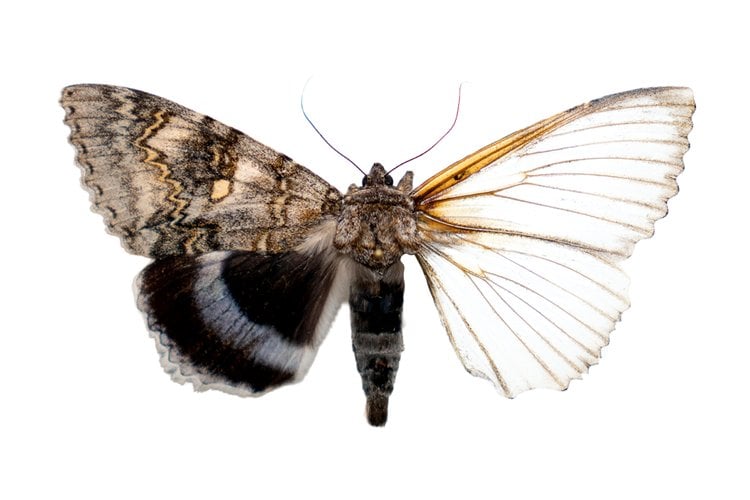
Every robot leaves the lab with its sensors already bolted on, picked from a best guess about where it will end up. Researchers at the University of Tartu in Estonia and the Italian Institute of Technology have built a moth-shaped robot that can add one later. They pumped an "artificial blood" through veins in its 3D-printed wings, shone UV light on a patch for about a minute, and that patch turned into a working UV sensor. A small onboard microcontroller then read the new sensor and made the robot flap its wings when UV hit it, something it could not do before.
How a printed wing grows a sensor
The body is printed from transparent PETG and copies the blue underwing moth, one of the largest moths in Estonia. Millimetre-wide veins carry liquid across wings of 86 square centimetres each, and the tiny gaps between printed lines act as microchannels that let the liquid soak about 10 micrometres into the plastic. One pump with open-loop control fills the whole body with about 3 ml of fluid.
The fluid is a mix of pyrrole, a light-activated initiator and a cellulose additive. Where UV light falls, the pyrrole inside the plastic polymerises into polypyrrole, a conductive polymer, and the clear wing turns black. When UV light hits that patch later, its electrical resistance briefly drops, which is all a microcontroller needs to detect it. A shape-memory wire flaps the wing, or an LED blinks.
Key details
- Body: 3D-printed PETG moth with fluid-filled veins, about 3 ml of "artificial hemolymph"
- Sensor material: polypyrrole grown in place by about one minute of UV exposure
- Precision: sensor patterns drawn through a stencil with 0.3 mm accuracy
- Response: onboard microcontroller detects the resistance drop and drives a shape-memory wire or an LED
- Shelf life: sensors still worked after more than four months of storage
- Paper: "Receptogenesis in a Vascularized Robotic Embodiment", Advanced Science, 23 Oct 2026 (DOI 10.1002/advs.76999)
An odd side effect: the sensor learns
The grown sensor did not behave like a calibrated part. Each UV exposure made it more sensitive, because leftover pyrrole kept polymerising. The team calls this a kind of material memory: the sensor's structure records what the robot has been through.
Our take
This is a proof of concept with clear limits. It uses one fixed chemical pathway, the change cannot be undone, the researchers chose when to fill the veins, and a stencil, not the environment, decided where the sensor formed. But the idea is worth watching for anyone building robots for places nobody has mapped. Instead of guessing where to put a photodiode before launch, the body itself grows the receptor where the signal actually arrives.
Image credit: Kadri-Ann Pankratov et al., University of Tartu / Estonian Research Council (natural and artificial moth wings), resized.
About the author: Aswinth Raj is an electronics engineer and the editor of CircuitDigest, where he has published more than 150 hands-on projects and tutorials across Arduino, PIC, ESP32, Raspberry Pi and EV battery systems. He selects the stories on this page for what engineers and makers can actually learn or build from. Connect on LinkedIn

Add a comment
No account needed. Your comment appears once a moderator has reviewed it.