

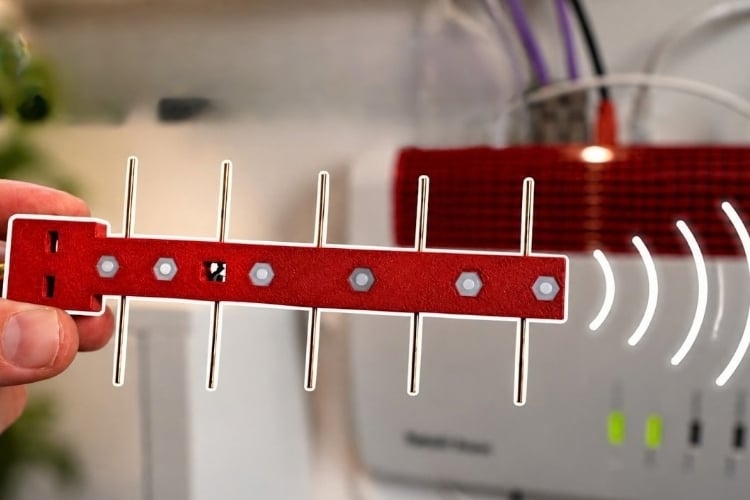
A maker has built and tested a DIY 2.4-GHz directional Wi-Fi antenna using a 3D-printed frame and simple brass rods, showing how antenna geometry can significantly change the performance of an ESP32 wireless link. The experiment uses two ESP32 boards, with one acting as a Wi-Fi transmitter powered by a power bank and the other connected to a computer as the receiver. The receiver measures RSSI (Received Signal Strength Indicator) from packets sent by the transmitter. With standard antennas, the link produced an RSSI of around −65 dBm over a distance of roughly 20 metres. When a commercial directional antenna was connected to the transmitter, the measured RSSI improved to around −50 dBm, demonstrating how concentrating RF energy toward the receiver can substantially improve the received signal level.
For the DIY version, the maker followed established Yagi antenna design principles and created a structure containing one driven element, three directors, and one reflector. The antenna elements were made from 1-mm brass rods and mounted on a 3D-printed non-conductive frame using nylon hardware, with a coaxial cable feeding the driven element. When connected to the ESP32 test setup, the homemade antenna achieved an RSSI of approximately −52 dBm, better than the −65 dBm result obtained with the standard antenna, although it did not match the commercial directional antennas. Rotating the DIY antenna away from the receiver reduced the RSSI to around −60 dBm, providing a practical demonstration of its directional behavior. The maker later measured the antenna's radiation pattern around 2442 MHz, the Wi-Fi frequency used in the test, using a motorized rotating measurement setup. The resulting plot showed a clear directional beam, demonstrating how a combination of RF antenna design, ESP32 Wi-Fi testing, 3D printing, and basic metal elements can produce a functional directional Wi-Fi antenna.

Add a comment
No account needed. Your comment appears once a moderator has reviewed it.