

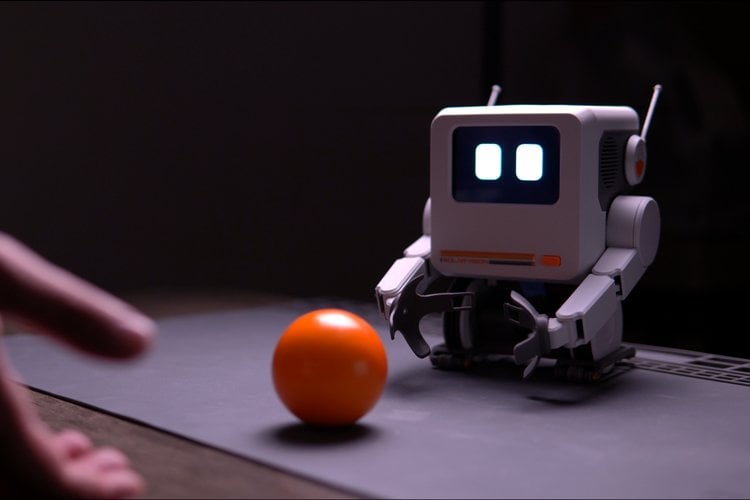
Most hobby robots that "follow a ball" just chase a colour blob. Sector 07 built one that plays a full game of fetch. His 3D-printed robot, called Fetch, uses an Arduino UNO Q and a custom vision model trained in Edge Impulse to find an orange ball, drive to it, grab it with two arms, then look for the owner's hand and bring the ball back, with no remote control. It is his first autonomous robot, and he puts the parts cost at around $300.
Two classes are enough
The vision model only has to know two things: the ball and a hand. He trained a two-class object detection model (Edge Impulse's YOLO-Pro) on photos taken through the robot's own camera, in different lighting and on different floors and backgrounds. About 200 images per class were enough to get it working reliably. The UNO Q pairs a Linux-capable processor, which can handle the camera and the model, with a separate microcontroller for real-time control, a split that suits a robot that has to see and move at the same time.
The rest is about character. Fetch has animated eyes on a small screen, antenna "ears" that move with its mood, and pre-recorded voice lines made with ElevenLabs.
Key details
- Controller: Arduino UNO Q
- Vision: custom two-class object detection model (ball and hand) trained in Edge Impulse, about 200 images per class
- Mechanics: mostly 3D printed, designed for snap and slide fits with few screws; two arms to pick up the ball
- Cost: about $300 in parts, according to the maker
- Openness: code, print files, schematics, parts list and assembly manual are going up on Arduino Project Hub (listing pending approval at the time of writing); the project was sponsored by Arduino
Our take
What makes this worth a look is how small the AI part is. Two classes and a few hundred photos taken with the robot's own camera are enough for a reliable fetch loop, which is a useful reminder for anyone who thinks on-device vision needs a huge dataset. The hard work was in the arms, the drive and the troubleshooting, and the video documents all of it.
Image credit: Sector 07 (YouTube), frame from the project video, cropped and resized.
About the author: Aswinth Raj is an electronics engineer and the editor of CircuitDigest, where he has published more than 150 hands-on projects and tutorials across Arduino, PIC, ESP32, Raspberry Pi and EV battery systems. He selects the stories on this page for what engineers and makers can actually learn or build from. Connect on LinkedIn

Add a comment
No account needed. Your comment appears once a moderator has reviewed it.