

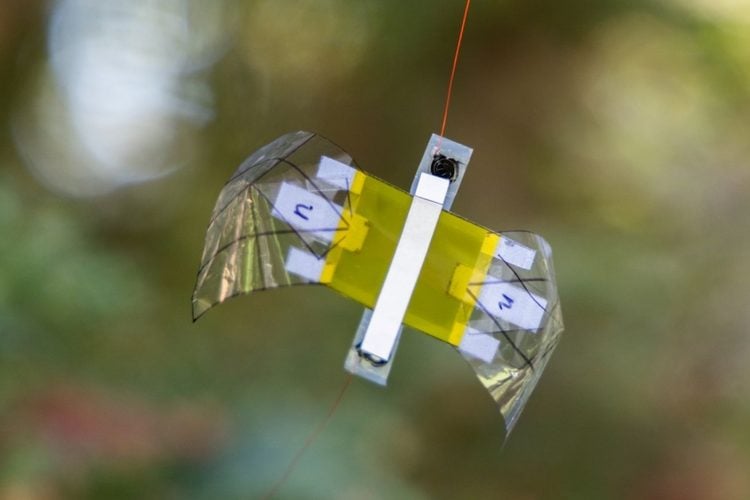
Most insect-sized flying robots are lab pets: one crash into a wall and a rigid hinge or gearbox snaps. A team led by Yuan Zhu, Hanxiang Wu and Professor Qibing Pei at UCLA, with Wenzhong Yan at UC Davis has built one that shrugs it off. Their 185 mg robot, lighter than a fifth of a gram, took off again after being hit with a flyswatter and after being flattened under aluminium blocks weighing about 11,000 times its own weight. The work is published in Science Robotics.
A wing muscle made of plastic film
There is no motor and no transmission. The wings are driven by a thin film of a relaxor ferroelectric polymer that expands when a voltage is applied, an effect called electrostriction, so switching the voltage on and off makes the layered actuator bend and flap the wings directly. The actuator reaches a 136 degree bending angle at 110 Hz with a power density of 1,600 W/kg.
The cone-shaped wings partly fold on one half of each beat and reopen on the other, which creates the difference in air resistance that gives upward lift. Because the wing material does not crease, the wings spring back to shape after an impact.
Key details
- Weight: 185 mg, all-polymer construction
- Lift: 3 times its own weight (lift-to-weight ratio 3.0 at 30 Hz), 8.3 mN per watt
- Take-off: unaided, climbing at about 40 cm/s
- Survived: collisions, a flyswatter hit and a crush load of about 11,000 times its weight
- Team: UCLA Soft Materials Research Laboratory, UC Davis and MIT (UC Davis announcement)
Our take
Be clear about what this is: the prototype is still tethered, with power coming in over thin wires, and it has no onboard battery, controller or sensors yet. Steering, landing and payload are the next steps. But durability is what has kept micro flyers in the lab, and solving it with materials instead of extra parts is the kind of idea that tends to stick.
Image credit: Mario Rodriguez/UC Davis, cropped and resized.
About the author: Aswinth Raj is an electronics engineer and the editor of CircuitDigest, where he has published more than 150 hands-on projects and tutorials across Arduino, PIC, ESP32, Raspberry Pi and EV battery systems. He selects the stories on this page for what engineers and makers can actually learn or build from. Connect on LinkedIn

Add a comment
No account needed. Your comment appears once a moderator has reviewed it.