
Explore all electronics projects from simple electronics projects to high-end MCU and IoT projects. These projects belong to a wide range of categories such as Embedded, Power Electronics, Analog, Digital Electronics, Audio and Internet of Things. The below list of electronics projects contains 1200+ projects come under various electronics engineering domains.
If you want more projects, you can also check out our collection at Arduino IoT Projects | Arduino Robotics Projects | Arduino AI Projects | Arduino Home Automation Projects | Raspberry Pi Projects | ESP32 Projects

Robotic Arms have proved themselves useful and more productive in many applications where speed, accuracy and safety is required. But to me, what’s more than that is these things are cool to look at when they work. I have always wished for a robotic arm that could help me with my daily works just like Dum-E and Dum-U that Tony stark uses in his lab. These two bots can be…

If you are an electronic enthusiast like me who wants to tweak around with different electronic circuits, having a decent Function Generator sometimes becomes mandatory. But owning one is a problem because such basic equipment can cost a fortune. Building your own test equipment is not only cheaper but also a great way to improve your knowledge.
So…

There are many types of LCDs used in Electronic Projects. We have already used 16X2 LCD in many of our projects and also used TFT LCD with Arduino. You can find our entire 16X2 LCD related project by following this link, including interfacing with 8051, AVR, Arduino and many more.
The ST9720 Graphical LCD is totally…

In this tutorial we are going to interface a seven segment display to ARDUINO UNO. The display counts from 0-9 and resets itself to zero. Before going further, let us first discuss about seven segment displays. You can also check this detailed tutorial on interfacing arduino with seven segment display.
A seven segment display got its name…

Battery cells are the most commonly used energy source to power portable electronics. Be it a simple alarm clock or an IoT sensor node or a complex mobile phone everything is powered by batteries. In most cases these portable devices need to have a small form factor (package size) and hence it is powered by a single cell battery, like the popular CR2032 Lithium cell or the…

Most of the Analog Electronic circuits require dual power supply rails for proper balanced operation; this gets especially critical if we are designing Operational amplifier circuits. Negative supply voltage is also required in digital systems like A/D converters, op amps and comparators. In all these cases, the current requirement will be low, but generating such a -5V…

Logic gates are the essential building blocks of digital circuits. These basic logic gates are used in Embedded Systems, Microcontrollers, Microprocessors, etc. Let us learn how to design the logic gates using VHDL in ModelSim. This tutorial is all about designing the basic logic gates using different VHDL modeling and their…

All embedded lovers are familiar with multimeter which a great tool to measure voltage, current, resistance etc. A multimeter can measure them easily. But sometimes we need to measure inductance and capacitance which is not possible with a normal multimeter. There are some special multimeters that can measure inductance and capacitance but they are costly. We already built…
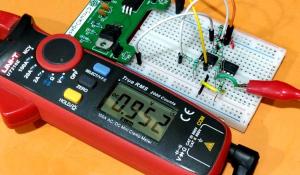
Almost all types of sensors and transducers convert real world parameters like light, temperature, weight etc into voltage values for our electronic systems to understand it. The variation in this voltage level will help us in analyzing/measuring the real world parameters, but in some applications like biomedical sensors this variation is very small (low-level signals) and…

Hi guys, during the last few weeks, I’ve been working on reconnecting with my love for the guitar. Playing the box guitar was how I relax few years back before the saxophone took over. Going back to the guitar, after 3 years of rarely strumming a chord, I discovered amongst other things that I no longer knew how each of the string should sound, to put it in my friend’s words…

Pulse Width Modulation (PWM) is a technique that varies the width of a pulse while keeping the wave frequency constant. The PWM technique mainly used to control the brightness of the LED, speed of DC motor, controlling a servo motor, or in other cases, where have to generate an analog signal using a digital source. We explained the PWM in detail in the previous article.…

A few years back, if someone were to tell me a watch could not only tell time but can also measure the heart rate and track calories, I would be blown away by it. Today more than a million people, including me own a wearable fitness tracker and it is forecasted that the market for wearable devices would reach $57,653 millions by 2022. From smart glasses to Diabetes…
