
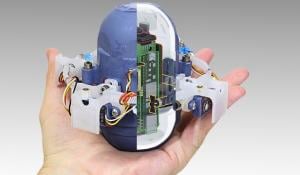
CARL is an autonomous underwater vehicle designed by researchers Peter Gunnarson and John O. Dabiri, this robot uses vortex rings, the spinning pockets of water, to move efficiently, reducing energy use by nearly 80%. Instead of constantly using its motors, CARL detects and rides these natural flows.
CARL is equipped with an inertial measurement unit (IMU), a sensor that detects motion…

While a skydriver falls from the sky or when a starship adjusts its position, they use air resistance to steer. This mechanism is used by this Floaty, a skydiver Robot made by Youtuber and researcher as a part of his PhD research which flies in a wind tunnel.
Floaty has flaps that tilt and adjust the air dynamics while floating, like how a skydriver spreads or tucks their arms and legs…

We often see multi-monitor setups and curved screens in gaming and workstation setups, but not in embedded systems. What if we could bring this idea to microcontrollers? Charles Giguère from The Last Outpost Workshop did exactly that by creating a curved display using multiple small screens and ESP32 microcontrollers.
The project started as an experiment to see if multiple ESP32…
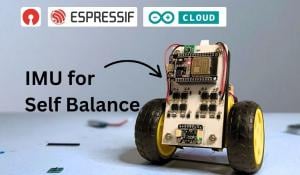
A developer has built a self-balancing robot featuring a custom motor control system powered by an ESP32 microcontroller. The system integrates an H-Bridge circuit with MOSFETs for efficient motor operation, allowing precise bidirectional movement and smooth speed adjustments through Pulse Width…
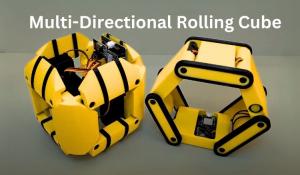
Robots come in many forms, but some can move in all directions just by adjusting their shape. Joshua Stanley, a creator on YouTube, has previously created Fred, a rolling robot with a hexagonal folding design. The creator took a different path this time and made improvements, hence the birth of Marc, a new multi-directional rolling cube.
The older version is much more complex, so he…
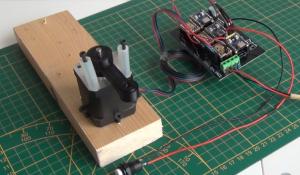
A Look at Sensorless Homing: Stepper Motor Control Without End Switches
Stepper motors play a crucial role in various industrial and DIY applications, providing precise control over movement in CNC machines, 3D printers, and robotic arms. Typically, these motors rely on external sensors or end switches to detect their home position or stop movement at a predefined point. These sensors…

Ever thought of turning a pistachio into a working AirPod? Well, a creative Penguin DIY just fixed earbuds into pistachio shell, by dismantling the earbuds, reducing their size, and fixing all the components into the same miniaturized board that will fit into a pistachio shell.
The process wasn’t easy. He had to meticulously remove, resize the board, and solder each tiny part onto the…
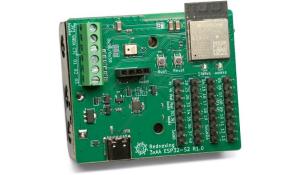
Rednexing, a North Carolina based startup, is preparing to launch a Crowd Supply campaign for PowerTortoise IoT, an ESP32-based development board designed for ultra-low-power operation. Built to run on standard AA batteries for up to eight years, this device is perfect for monitoring temperature and humidity in hard-to-reach areas like attics, crawlspaces, and storage spaces where wired…
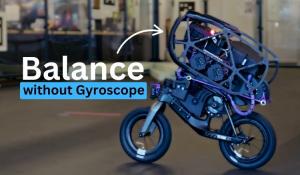
The Robotics and AI (RAI) Institute has developed the Ultra Mobility Vehicle (UMV), a self-balancing robotic bike capable of navigating challenging terrain and even jumping onto high surfaces. Reinforcement learning (RL) is playing a key role in helping robots adapt to complex situations and perform better.
Unlike traditional…
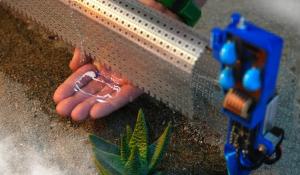
Water scarcity remains one of the most pressing challenges of our time, particularly in dry regions where access to fresh water is a constant struggle. While traditional solutions involve drilling deeper wells or implementing inefficient fog nets, a new approach leveraging high-voltage physics could revolutionise water collection. In a new experiment, Jay Bowles from the Plasma Channel tested…
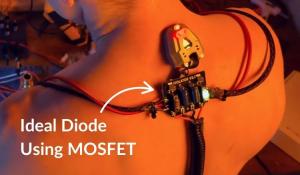
A YouTuber has developed a combat suit featuring a spinal battery system designed for improved power efficiency and reliability. The system includes voltage regulation, overcurrent protection, and cell isolation to prevent damage from physical impacts.
The suit incorporates an "ideal diode" circuit using MOSFET-based switching…
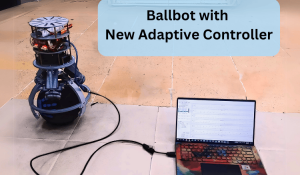
Ballbots are a fascinating type of robot that can move in any direction, but controlling them is no easy task. Traditional controllers, like PID (Proportional-Integral-Derivative), struggle to handle these balancing issues, while more advanced methods can cause instability and excessive movements.
A team of researchers, led by Dr. Van-Truong Nguyen from Hanoi University of Industry,…