
inductance

|
Simple DIY FM Receiver Circuits on the Internet - Do they Really Work? Recently, we thought of building a simple FM receiver circuit, so, like always, we started googling for possible circuits that can be used to fulfil our requirements, and as expected, we found a lot of circuits on the internet, but the question remains, how good or useful will they be when we put those circuits to the test? Because just like us, we found a lot of… |

|
How to Design a Coil - Air Core, Ferrite Core and Toroidal Core Winding Every hobbyist wanting to dabble in radio has to – at some point – wind a coil or two, be it the antenna coil of an AM radio, a coil on a toroidal core for a bandpass filter in a communications transceiver or a centrally tapped coil for use in a hartley oscillator. Winding coils is not hard but quite time-consuming. There are different methods of making coils, depending on… |

|
Understanding Maxwell Equations Maxwell equations are the fundamentals of Electromagnetic theory, which constitutes a set of four equations relating the electric and magnetic fields. Instead of listing out the mathematical representation of Maxwell equations, we will focus on what is the actual significance of those equations in this article. The Maxwell’s First and Second equation deals with static… |

|
What is DCR in Inductors and how does it affect your circuit design Inductors are widely used passive components in electronics after resistors and capacitors. An ideal inductor stores energy in a magnetic field and delivers a smooth output current to the load. But in a practical circuit, an inductor also contains some low value resistance associated with its inductance property. During the flow of DC supply or to be specific in 0 Hertz… |
|
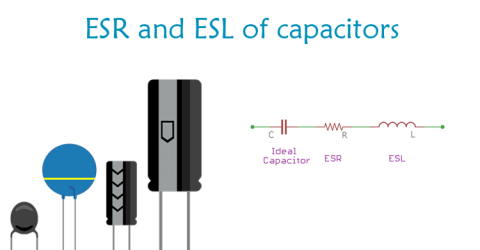
Understanding ESR and ESL in Capacitors The most used electronics components in any electronic design are Resistors (R), Capacitors (C), and the Inductors (L). Most of us are familiar with the basics of these three passive components and how to use them. Theoretically (under ideal conditions) a capacitor can be considered as a pure capacitor with only capacitive properties, but in practice a capacitor will… |
|
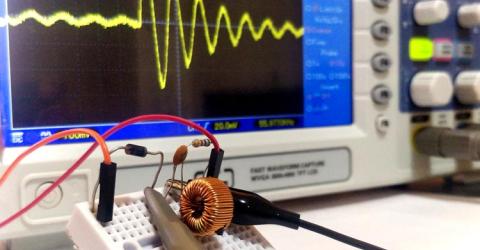
How to measure value of Inductor or Capacitor using Oscilloscope – Resonant Frequency Method Resistors, Inductors and Capacitors are the most commonly used passive components in almost every electronics circuit. Out of these three the value of resistors and capacitors are commonly marked on top of it either as resistor colour code or as numeric marking. Also the resistance and capacitance can also be measured using normal Multimeter. But most of the inductors,… |

|
LC Meter using Arduino: Measuring Inductance and Frequency All embedded lovers are familiar with multimeter which a great tool to measure voltage, current, resistance etc. A multimeter can measure them easily. But sometimes we need to measure inductance and capacitance which is not possible with a normal multimeter. There are some special multimeters that can measure inductance and capacitance but they are costly. We already built… |