
Automotive

|
Are Solar Powered Electric Cars Possible? Reasons Why We Don’t Have One Commercially Available Yet Transportation accounts for around 30% of our carbon dioxide emissions in the atmosphere globally. The number of fossil fuel cars is set to double by 2040. Various automobile companies have been working on electric vehicles but these vehicles have some dependency on fossil fuels. What then could be the smart solution to cut down the percentage of carbon dioxide emissions… |
|
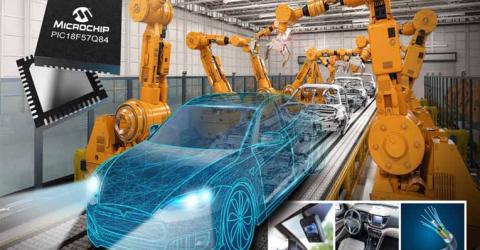
PIC18-Q84 Family of 8-bit Microcontrollers Combine CAN FD and Core Independent Peripherals to Increase System Capabilities in Automotive Applications To help automotive designers meet the rising need of increased bandwidth and flexible data, Microchip Technology has come up with the PIC18-Q84 family of 8-bit MCUs designed for automotive interface and smart sensor networks. Accompanied by an extensive array of Core Independent Peripherals (CIPs) that handle a variety of tasks without requiring CPU intervention, these… |

|
Low Profile Automotive Grade Proximity Sensors with High Resolution to Prevent False Triggers in Consumer and Industrial Applications Vishay Intertechnology has announced the launch of two new automotive-grade proximity sensors, namely VCNL3030X01 and VCNL3036X01, with high resolution up to 20 µm for force sensing applications. These new low profile SMD packaged devices can prevent false triggers in automotive, consumer, and industrial applications. The sensors feature an IRED / LED pulse current… |

|
TrustAnchor100 CryptoAutomotive Security IC with Pre-Programmed Security Features for Reducing Cost and Time to Market Microchip has released the TrustAnchor100 (TA100) CryptoAutomotive Security IC with pre-programmed security features to simplify automotive network security. The new cryptographic companion device provides OEMs and module suppliers with a simplified path to automotive network security, thereby reducing costs and time to market. The TA100 supports in-vehicle network… |

|
Automotive GaN FET with Integrated Driver, Protection and Active Power Management can Reduce Board Space and Improve Power Density in Automotive Applications Texas Instruments has expanded its portfolio of high-voltage power management devices with the next generation of 650-V and 600-V gallium nitride (GaN) field-effect transistors (FETs). The fast-switching and 2.2-MHz integrated gate driver allows the device to deliver twice the power density, achieve 99% efficiency, and reduce the size of power magnetics by 59% compared… |

|
New 32-bit Arm Cortex M7 Microcontrollers (S32K3) from NXP to Tackle Cost and Complexity of Automotive Software Development Expanding its S32K product line, NXP Semiconductors has come up with the new S32K3 microcontroller (MCU) family for automotive body electronics, battery management, and emerging zone controllers. Simplifying software development with an enhanced package that spans security, functional safety and low-level drivers, the newest member of the family enables software reuse… |

|
Low Cost Automotive Sequential LED Lighting IC for Reducing Design Complexity and Development Maxim Integrated has introduced the MAX25605 sequential LED controller aiming to reduce design space up to 50% and to cut the bill of materials (BOM) costs by up to 25% compared to similar solutions in the market. The new device eliminates the need for a microcontroller or software. This saves development time and reduces design complexity. The… |

|
Automotive Microcontrollers from STMicroelectronics to Maximize Safety and Security in Next-Generation Domain/Zone Architectures ST jointly with Bosch has developed deterministic high-performance open-market MCUs that can host multiple applications, including virtualization of safety and security by HW functionality. This new approach enables integration of multiple applications developed with different tooling and on different software schedules, in contrast to today’s Linux/Posix-based integration-… |

|
40V Dual MOSFET with Low Drain-Source Resistance in Compact 3.3mm x 3.3mm Package for Automotive Applications Diodes Incorporated introduced DMT47M2LDVQ automotive compliant 40V dual MOSFET in a 3.3mm x 3.3mm package for automotive systems. It smartly integrates two n-channel enhancement-mode MOSFETs with the lowest RDS(ON) (10.9mΩ at VGS of 10V and ID of 30.2A). The low on-resistance conduction helps in keeping the losses to a… |

|
Maxim Integrated’s Automotive Buck-Boost Controller Enables Automotive USB Power Delivery Ports with Industry’s Smallest Solution Size and Lowest Cost Designers of automotive chargers now have the industry’s smallest and lowest-cost solution with the MAX25430 100W USB Power Delivery (PD) buck-boost controller and protector from Maxim Integrated Products. As the industry’s most integrated solution, the MAX25430 can reduce design size up to 40 percent compared to competitive solutions and offer the industry’s lowest cost for… |

|
New surface-mount, Automotive Grade Photodiodes in a Compact 0805 case for Detecting Visible and Near-Infrared Radiation Vishay Intertechnology has introduced VEMD4010X01 and VEMD4110X01, two new surface-mount, Automotive Grade silicon PIN photodiodes in the compact 0805 case size with a low 0.7mm profile. The VEMD4010X01 can be used for detecting visible and near-infrared radiation with a wide sensitivity range from 550 nm to 1040 nm. For 740 nm to 1040 nm infrared applications, the… |

|
Automotive Qualified ESD Protection devices with High Signal Integrity, Low Clamping voltage, and High Surge Robustness Nexperia has introduced four new AEC-Q101-qualified TrEOS ESD protection devices for automotive use. The new TrEOS components can withstand high temperatures up to 175°C, and they combine extremely low capacitance for high signal integrity, extremely low clamping, and high robustness for modern automotive interfaces. The capacitance of the device is… |