

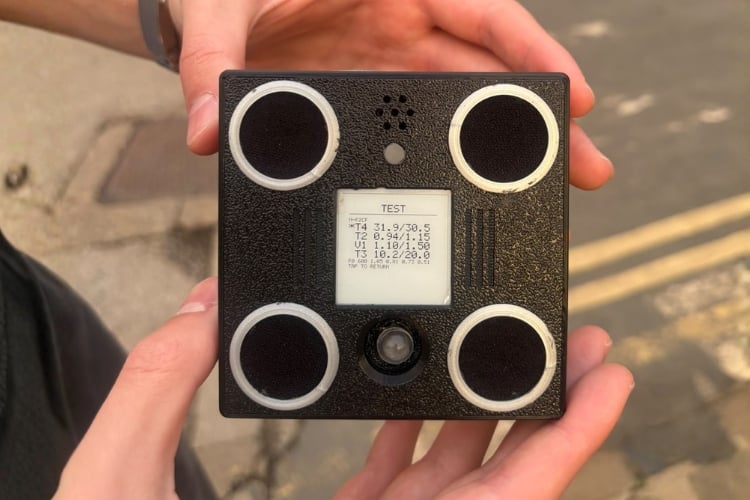
A maker named Agam Rossen has created VolAnti, an open-source acoustic drone detector that identifies nearby multirotor drones by listening to the sound of their propellers. Unlike traditional drone detectors that look for radio-frequency signals, VolAnti focuses on the sound produced by spinning blades. This approach is particularly relevant to fibre-optic-controlled FPV drones, which send control and video data through a physical fibre-optic cable instead of a normal wireless radio link. Since these drones may not produce a useful RF signal, an acoustic detector can provide another way to detect their presence. The project is designed as a detection and alert system, not as a device for jamming, intercepting, or disabling drones.
VolAnti is built around an ESP32-S3 microcontroller and four ICS-43434 digital MEMS microphones. The microphones are arranged on a custom PCB, and their audio signals are combined before being processed by the ESP32-S3. The firmware samples the audio at 16 kHz and runs a 2,048-point Fast Fourier Transform every 32 milliseconds. Instead of checking only whether the environment is loud, the software searches for a repeating harmonic pattern created by drone propellers. It examines possible blade-pass frequencies between 70 Hz and 2,000 Hz and uses several detection methods in parallel. This is important because a drone that remains hovering can produce a steady sound that may otherwise be mistaken for background noise. It includes a 1.54-inch e-paper display, buzzer, RGB LED, vibration motor, and a Ra-01H LoRa radio. When a drone-like acoustic signature is detected, the unit can produce a local warning and send an alert to other VolAnti devices on the network. The e-paper display can retain the last alert even when the power is removed. The hardware also includes a BQ24074 battery charger, a TPS63020 buck-boost converter, and a 2,500 mAh LiPo battery.
VolAnti is intended for early warning and situational awareness in places where detecting small drones is important, including areas affected by drone activity, restricted zones, and locations where radio-based detection may not work reliably. Its distributed LoRa design also allows multiple units to share alerts, creating a network of low-cost acoustic sensors. During testing, the creator reported detecting a hovering quadcopter at a measured distance of 104 metres in light wind and on a busy street. The project page also reports an alert response of approximately 0.23 seconds from the first detected sound.
The main limitation is that VolAnti listens to sound, so its performance depends heavily on the environment. Wind, traffic, machinery, conversations, music, buildings, and other loud sources can make detection more difficult or create false alarms. It detects a possible drone acoustic signature, but it does not identify the exact drone model, provide radar-style tracking, or determine the drone’s direction. Its range can also change with the drone’s size, propeller type, flight speed, altitude, and background noise.

This will not work.
Add a comment
No account needed. Your comment appears once a moderator has reviewed it.