

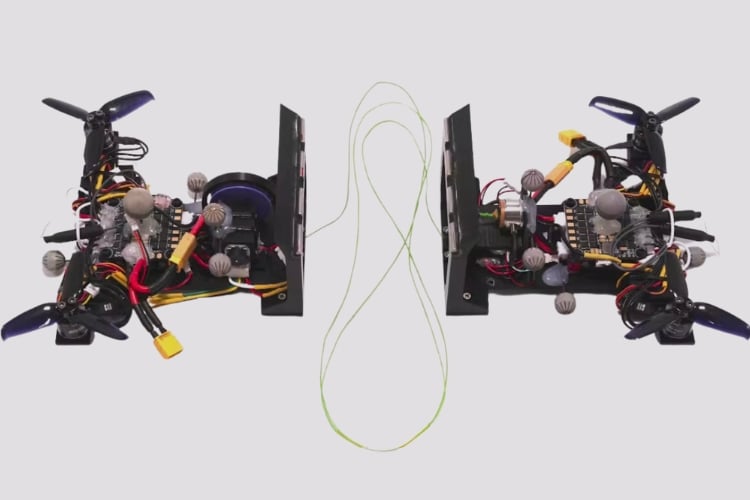
Researchers led by R.Wang have developed a transformable aerial robot made from two small bicopters connected by a cable, allowing the system to change its shape and interact with objects without using a conventional robotic gripper. Each bicopter uses two brushless motors with tilting propellers, while the cable itself acts as the key mechanical component. One aircraft carries a motorized winch and encoder to control the cable length, while the other measures cable tension using a force sensor. Magnets underneath the aircraft allow them to lock together when the cable is fully reeled in.
The system has three operating modes. With a slack cable, the two bicopters can fly independently while remaining connected; by controlling cable tension, they can fly together and use the cable to apply forces to objects, move suspended payloads, or wrap around structures for perching. When the cable is reeled in, the two aircraft join together to form a single quadcopter, giving the system a more compact configuration for navigating confined or cluttered spaces. Researchers developed separate control methods for these modes and demonstrated stable transitions between them, including changing configurations while airborne. During testing, the system also carried a 40-gram suspended payload and demonstrated operation with limited position feedback.
From an electronics perspective, each 165-gram bicopter uses two 6,000-KV brushless motors, two servo motors for thrust-vector control, a Crazyflie Bolt 1.1 flight controller, a 4-in-1 ESC, and a 500-mAh 2S LiPo battery. The researchers see the design as a way to handle access-then-interact missions, where a drone first needs to reach a difficult location and then physically interact with its surroundings. Potential areas include infrastructure inspection, environmental monitoring, search-and-rescue situations, and other tasks requiring aerial robots to navigate, perch, pull, or carry lightweight objects; however, these represent application areas for the technology rather than capabilities demonstrated in every one of those settings.

Add a comment
No account needed. Your comment appears once a moderator has reviewed it.