

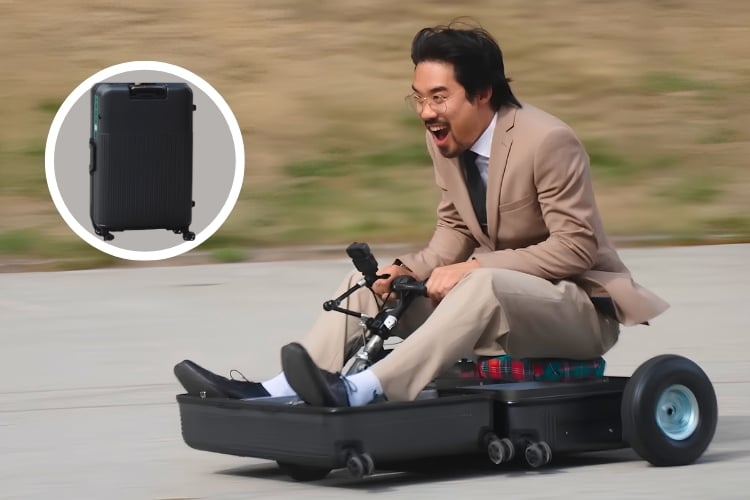
In 1991, Mazda built one of the strangest vehicles ever made, a car that could fold into a suitcase. Only three promotional prototypes were created, and just one is believed to have survived. Instead of trying to find the original, a maker from the YouTube channel Bucket decided to build a working replica from scratch. The original Mazda Suitcase Car used a square tube chassis, solid rear axle, front pit bike fork and a 33.6cc two stroke Komatsu engine, with the entire vehicle designed to fold inside a Samsonite suitcase. The recreation follows the same basic idea but uses a newer Samsonite Rexton suitcase as the body and rebuilds the internal chassis and drivetrain around it.
The build starts with an aluminum and square tube frame fitted inside the suitcase, with custom welded mounts supporting the engine, axle and other mechanical parts. A 33.6cc engine provides power through a chain driven drivetrain, using a modified Razer E300 sprocket connected to the rear axle. The front end uses a Razer E100 electric scooter fork, wheel and brake, while pillow block bearings support the axle. One of the biggest challenges was making the vehicle turn, since the original style of solid axle setup does not allow the wheels to rotate at different speeds. McCune solved this by modifying the axle with an additional bearing arrangement that allows the two sides to rotate independently. The folding chassis is locked together using sliding bolts and threaded knobs, turning the two separate halves into one rigid frame when the vehicle is ready to drive.
The final result is a fully working DIY Mazda Suitcase Car replica that folds back into a portable suitcase. The build also includes a custom seat with 3D printed TPU locating pegs, removable handlebars, folding wheels, chain guard, fuel tank and exhaust system. After completing the build, the recreated vehicle reached 33 km/h, slightly faster than the approximately 30 km/h reported for the original, while weighing 56.8 lb. It may not be the most practical form of transportation, but McCune's project shows how mechanical design, welding, fabrication, 3D printing and parts from other vehicles can be combined to recreate one of Mazda's most unusual concept vehicles.

Add a comment
No account needed. Your comment appears once a moderator has reviewed it.