
 Vedhathiri
Author
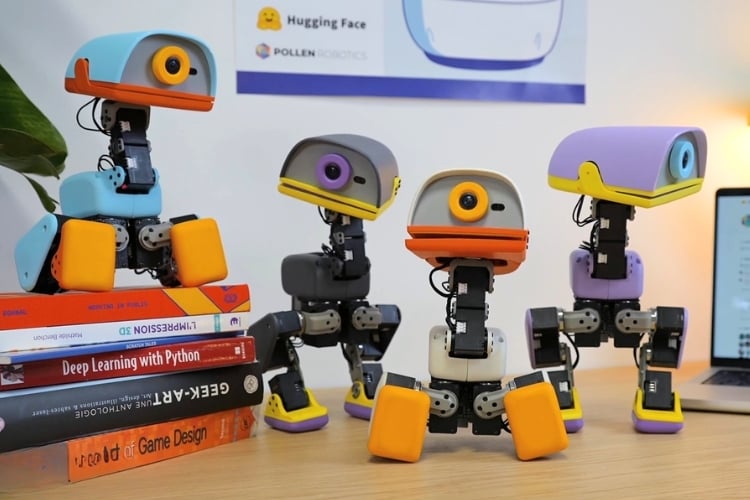
Hugging Face and Pollen Robotics just launched a tiny robot that could change how people learn robotics at home. Called Microduck, this 25cm tall, 780 gram biped robot is built specifically for reinforcement learning and physical AI and it costs just $399. Unlike Reachy Mini, which was designed primarily around interaction and conversational AI, Microduck focuses on physical movement and reinforcement learning.Its 15 motors are spread across its legs, neck, and head, letting it walk with a distinctive waddling gait, sit, crouch, roller-skate on clip-on skates, kick a ball around, and even get back up on its own after falling flat on its back. Instead of arms, it uses a hinged, articulated beak that works as a small gripper: the whole body lowers, the beak dips down and closes around an object like a sock or a marker, and then it stands back up.
What makes Microduck genuinely useful for developers is its open source software stack, built around what's called a "sim-to-real" workflow. Training a robot through pure trial and error directly on real hardware would take far too long and would quickly damage the motors, so instead, developers train new skills inside a physics simulator first either on their own computer or through available cloud-based training infrastructure. Once a trained behavior looks solid in simulation, it gets deployed to the real robot in a single step, and developers can then watch how it actually performs, tweak the simulation to correct any issues, and redeploy an improved version, repeating that loop as many times as needed. All of the onboard computing happens on a Rockchip RK3566 chip, which includes a built-in AI accelerator, 1 GB of RAM, and 32 GB of storage,the robot's onboard policy loop runs at 50 Hz, processing and updating control commands 50 times per second to keep walking and balance smooth and stable. Beyond the chip, the robot is packed with sensors: a front-facing wide-angle camera for vision, an 8x8 time-of-flight LiDAR sensor for measuring distance, two IMUs (one in the body and one hidden in the head like an eye) to track balance and body position, plus microphones, a speaker, Wi-Fi, Bluetooth, and dual NFC antennas hidden in the head and beak that can trigger specific moves when a tagged object comes close. Because all of this runs locally on the chip, Microduck works completely offline, though developers can optionally connect to Hugging Face's servers to train, store, and share their trained policies with the wider community. A removable 2,600 mAh camera-style battery powers the robot for roughly an hour, and keeping a spare charged means no downtime between practice sessions. Programming the robot day-to-day is handled through a simple command-line tool called robotctl, used to check the robot's status, change its configuration, and push software updates, while the actual skill-building happens in the simulator.
The complete SDK, simulation environment, and reinforcement learning tools are freely available on GitHub, split across two repositories the main Microduck repo for the SDK and robot control software, and Microduck RL for the training and sim-to-real tools so anyone can read the code, fork it, or build their own custom behaviors on top of it.It ships in four different colorways Cream, Graphite, Lavender, and Sky and interestingly, each Microduck has its own distinctive generated voice, giving every robot a slightly different personality. So it communicates through quirky noises rather than actual words.At just 25 cm tall, the robot is therefore more than a miniature walking machine; it is designed as an accessible platform for experimenting with reinforcement learning, physical AI, robotics simulation and real-world robot control.