

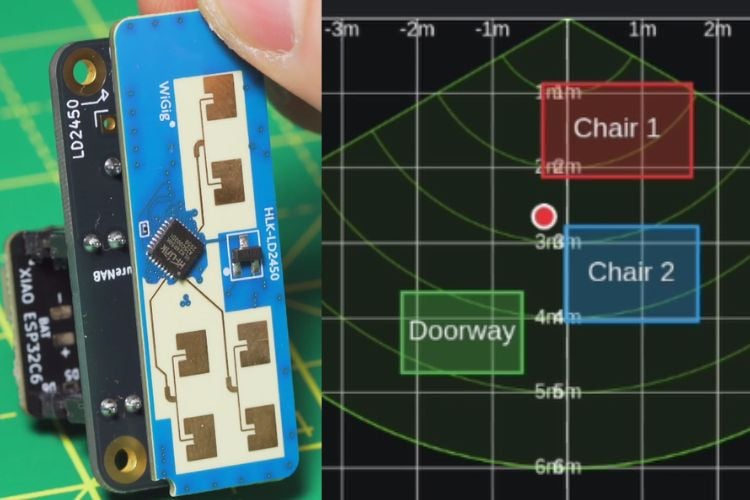
Traditional infrared presence sensors are cheap, but unreliable for smart homes, often turning off lights if you remain still for even a few seconds. Millimeter-wave (mmWave) radar modules offer a far superior alternative by detecting micro-movements like breathing and even tracking a person's exact 2D position in a room. However, commercial mmWave presence sensors can cost anywhere from $40 to $100. To solve this pricing barrier, github user FeatureNAB designed an open-source, DIY mmWave sensor that delivers premium features for around $10 per unit.
The custom hardware relies on an ESP32-C6 microcontroller which natively supports Wi-Fi, Zigbee, Thread, and Bluetooth with a mmWave radar module. The design supports two popular sensor configurations: a 3-antenna radar module capable of 2D target tracking and zone detection, and a high-gain DF Robot board that trades spatial tracking for extreme sensitivity across extended ranges. To ensure smooth integration and room for expansion, the project incorporates I²C breakout headers for temperature and humidity sensors, power-smoothing capacitor pads to prevent ESP32 Wi-Fi brownouts, and seamless, zero-code integration with Home Assistant via ESPHome.
Bringing the project to life required overcoming several engineering hurdles, including a PCB routing fix for mismatched connectors and thermal management. The hardware is housed in a custom 3D-printed enclosure featuring a friction fit, a USB cable guide, and an adjustable ball-and-socket joint for precise positioning. All schematic files, STL models, and ESPHome configurations have been released open-source on GitHub for anyone to build at home.

Add a comment
No account needed. Your comment appears once a moderator has reviewed it.