




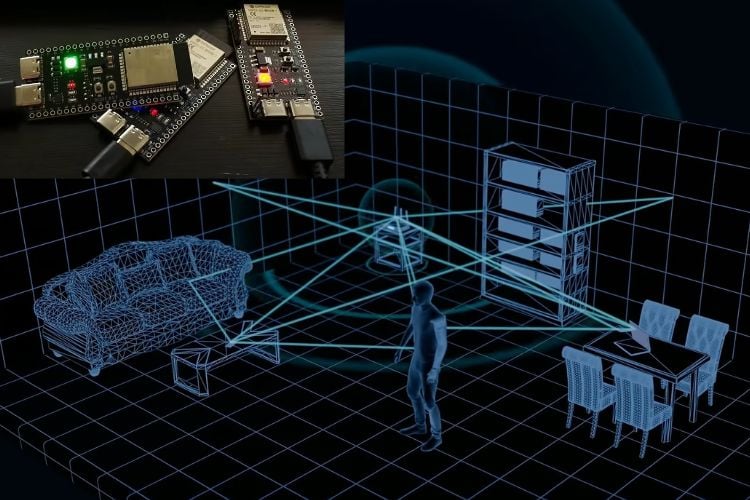
Better Stack from Youtube recently used an open-source project called RuView and explored how Wi-Fi signals can be used to detect human presence and movements without relying on a camera. He describes how Wi-Fi signals change as he travels through a room and bounce off walls, furniture, and people. When someone moves, their body alters the signal's strength and phase across different frequency bands. By collecting and analysing these changes, a machine learning model can learn to recognise movements such as sitting, standing, walking, and squatting. The approach uses a camera-based pose detection model during training to teach the Wi-Fi model what different movements look like, after which the camera can be removed for live detection.
To test the technology at home, he built a setup using 3 ESP32-S3 development boards and flashed them with RuView's open-source firmware. The boards were placed at different positions in the living room to create multiple Wi-Fi sensing paths, allowing the system to capture movement from different angles. A webcam running Google's MediaPipe pose detection library recorded the movements during training, while the ESP32-S3 boards collected Wi-Fi signal data. After approximately nine minutes of training across several movements, the creator tested the model in a separate live session. The system achieved an overall accuracy of 79.5% across eight movements, with jumping reaching 97%, sitting 93%, spinning 92%, and standing 84%. However, it struggled to recognise waving, achieving only 13% accuracy. The system also detected whether the room was occupied with 96% accuracy during the test.
Although the experiment demonstrates the potential of camera-free motion sensing, the creator highlighted several limitations. The model was trained and tested in a single room with one person, so changing the board positions or introducing another person could require retraining. Privacy is another concern, as Wi-Fi sensing could potentially reveal whether someone is present or moving inside a room without a camera being pointed at them. At the same time, the technology could support camera-free home security, fall detection, and monitoring the daily activity of elderly people living alone. The video also discusses the IEEE 802.11bf Wi-Fi sensing standard, which was developed specifically for this type of sensing. While the technology is still evolving, the experiment shows how affordable ESP32-S3 hardware and machine learning can turn ordinary Wi-Fi signals into a practical human motion detection system.
