

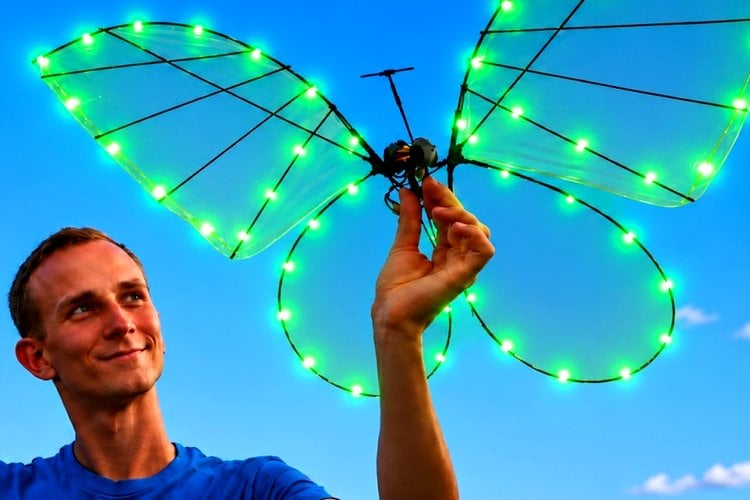
Propellers make flying easy. Flapping wings do not. Maker Max Imagination still built ESP-FLUTTER, a 70 g remote-controlled butterfly that lifts off on its own wings, glows at night with LEDs along the wing edges, and can be flown from a phone browser. The firmware is open on GitHub, and the project was picked up by Hackster on 2 November.
Two servos instead of one crank
ESP-FLUTTER is an ornithopter. Many ornithopters use a single motor and a linkage to flap both wings together. This one gives each wing its own high-speed coreless digital servo, so the software controls the wing motion directly. Steering comes from moving the two wings differently, and ordinary hobby servos were not fast enough. A Seeed Studio XIAO ESP32-C3 generates the servo signals, hosts the Wi-Fi web app, monitors the battery and drives the LEDs. An optional ExpressLRS receiver lets you fly it with a normal RC transmitter, and ESP-NOW is supported too.
The web app exposes the flight tuning: flapping frequency, steering response, servo positions and the wing motion profile. A sine wave gives smoother, more natural flapping, while a triangle wave gives more lift. About 4 Hz at full throttle worked well.
Built light
The frame is printed in PETG, with TPU guards to protect the servos in crashes. The wings are thin plastic produce bags stretched over carbon fibre rods. The 50 or so SMD LEDs are wired with very thin enamelled copper wire and add only about a gram per wing. There is a modular version made from easy-to-find parts and a compact version on a custom four-layer PCB.
Key details
- Controller: Seeed Studio XIAO ESP32-C3
- Control: phone web app over Wi-Fi, ESP-NOW, or ExpressLRS RC receiver; phone-tilt control
- Actuators: two high-speed coreless digital servos, one per wing
- Power: 2S 220 mAh 45C LiPo
- Weight: 70 g with battery
- Flight: about 5 minutes per battery, longest continuous flight 1 min 9 s, about 25 m range over Wi-Fi
- Files: firmware on GitHub, Gerbers and diagrams in the project folder, 3D files on Cults3D
Our take
This is a good example of moving complexity from mechanics into software. Two independent servos cost a little weight, but they replace a fiddly gearbox and turn wing shape, frequency and steering into numbers you can tune from a phone. The 69-second record flight shows it is still a hard problem, but every part of it is open for anyone who wants to push it further.
Image credit: Max Imagination (YouTube), frame from the project video thumbnail, cropped and resized.
About the author: Aswinth Raj is an electronics engineer and the editor of CircuitDigest, where he has published more than 150 hands-on projects and tutorials across Arduino, PIC, ESP32, Raspberry Pi and EV battery systems. He selects the stories on this page for what engineers and makers can actually learn or build from. Connect on LinkedIn

Add a comment
No account needed. Your comment appears once a moderator has reviewed it.