

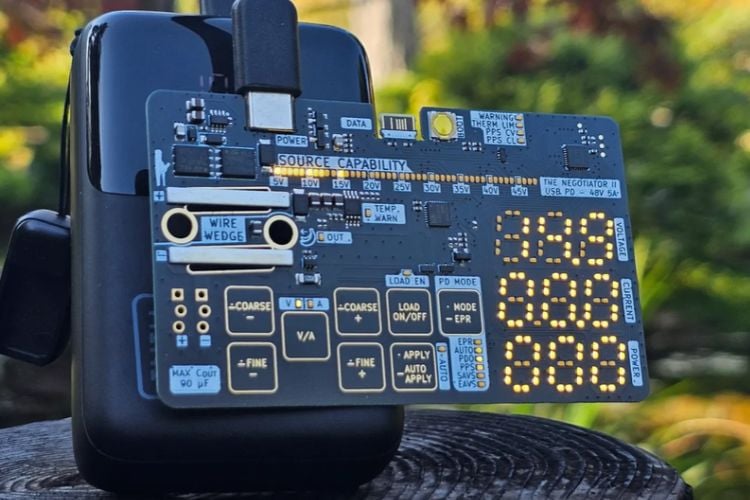
Electronics and mechanical engineer Anas Malas has redefined networking hardware with The Negotiator II, a smart printed circuit board (PCB) business card that doubles as a portable USB Power Delivery (USB PD 3.1) lab power supply. Measuring just 2 mm thick, the wallet-sized card features nearly 200 surface-mount LEDs, dual USB-C ports, and live telemetry displays for voltage, current, and wattage. Rather than handing out traditional paper cardstock, Malas offers a functional engineering tool capable of converting standard, off-the-shelf USB-C chargers into adjustable benchtop power sources anywhere in the field.
Behind its compact form factor lies significant power delivery intelligence. Modern USB-C chargers contain sophisticated microcontrollers that withhold higher outputs until specific handshaking protocols take place. The Negotiator II communicates directly with connected power sources to trigger and unlock custom voltages ranging from 5V up to 48V in 0.1V increments at up to 5 Amps (240W). An onboard LED capability bar instantly audits connected chargers to display available profiles including Programmable Power Supply (PPS) and Adjustable Voltage Supply (AVS) modes.
Despite packing high-voltage protection and real-time monitoring into a 4-layer ENIG plated PCB, Malas optimized the design to achieve a production cost of roughly $8 per unit in batches of 100. To protect against accidental 48V shorts across sensitive USB data lines without resorting to costly protection ICs, the design employs low-cost depletion-mode MOSFETs. The board also interfaces with a companion Web Serial console via Chrome or Edge, allowing users to view live power graphs, diagnose charger behavior, and update firmware over the air. Malas plans to open-source the underlying USB PD 3.1 software library, offering maker and hardware communities an ultra-accessible blueprint for custom power management.