
 Vedhathiri
Author
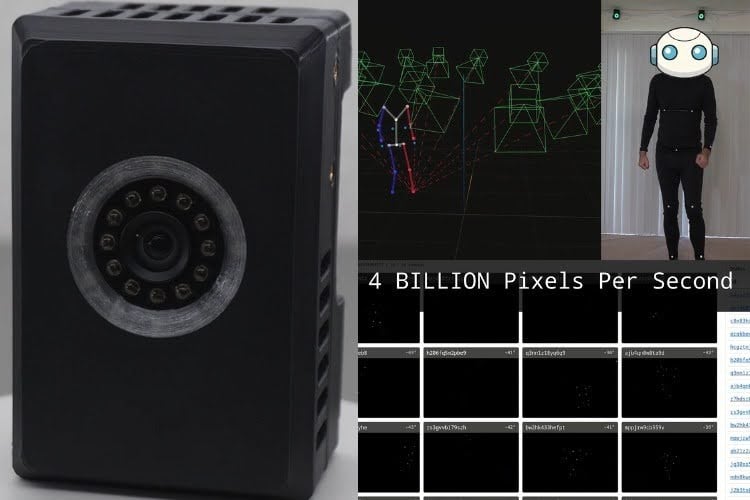
The YouTube creator Matt has developed an impressive open-source motion capture (MoCap) camera system that delivers professional-level 3D tracking at a much lower cost than existing commercial solutions. The project uses 16 custom-built infrared cameras that work together to capture and process more than four billion pixels every second. These cameras can track objects with an accuracy of less than 0.5 millimeters, making the system suitable for robotics, virtual reality, animation, and scientific research. Instead of relying on expensive hardware found in many professional systems, Matt uses affordable Raspberry Pi Compute Modules and custom-designed electronics to achieve high performance while keeping costs low.
The system works by placing special reflective markers on an object or person. Each camera shines invisible infrared light onto the markers, making them appear as bright white points in the captured images. The cameras then detect these points and send only their coordinates to a central computer instead of transmitting full video, greatly reducing data traffic and improving processing speed. To ensure maximum accuracy, all 16 cameras are synchronized using Precision Time Protocol (PTP), allowing them to capture images at exactly the same moment with an error of less than 50 nanoseconds.
Another impressive feature of the project is its focus on efficiency and smart engineering. The cameras use custom software that processes images much faster than traditional computer vision methods, reducing delays and enabling real-time performance. High-power infrared LEDs, passive cooling systems, and custom circuit boards further improve the design while keeping power consumption under control.
The open-source 16-camera infrared system capable of sub-millimeter 3D tracking with nanosecond-level synchronization all at a fraction of the cost of commercial solutions.