
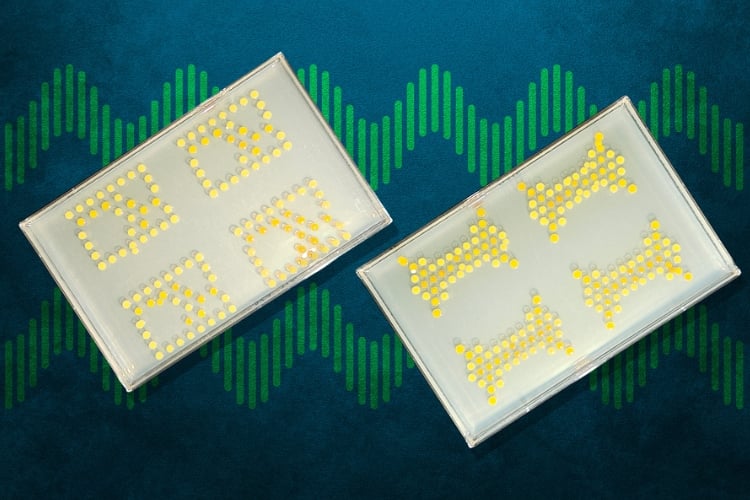
MIT researchers have built working logic circuits using engineered bacteria, creating biological versions of components that electronics engineers would normally associate with transistors, relays and digital logic. The work uses Pantoea agglomerans, a bacterium that commonly grows on surfaces, including plants. The researchers modified the cells so they could function as two types of biological transistors, which respond to specific chemical inputs and produce molecular signals that can be passed to other engineered bacterial cells. Three additional bacterial strains were designed to act as relays, translating one molecular signal into another so multiple components can be wired into larger circuits. Instead of copper traces and electrical signals, the researchers arranged colonies of bacteria on agar plates about 5 millimeters apart, relying on chemical signaling to move information from one colony to the next in a controlled direction.
Using these building blocks, the team demonstrated several logic operations, including multi-input, OR, and imply gates, and combined components into larger circuits, including a demultiplexer and a circuit that adds two inputs together. The largest demonstrated circuit contained 24 bacterial colonies. Spreading a circuit's functions across multiple cooperating cells, rather than packing everything into one cell, is one way synthetic biologists have tried to work around the crowding and interference that can occur when a single cell is asked to run too many engineered functions at once.
The system is extremely slow compared with electronic hardware, taking about eight hours to complete a calculation, so the researchers aren't proposing bacteria as a replacement for conventional computers. Instead, the goal is to bring programmable computation directly into biological environments. One potential application is agriculture: engineered bacteria placed on plant roots or leaves could eventually detect conditions like drought or pest attacks and trigger an appropriate biological response without conventional electronic hardware.

Add a comment
No account needed. Your comment appears once a moderator has reviewed it.