

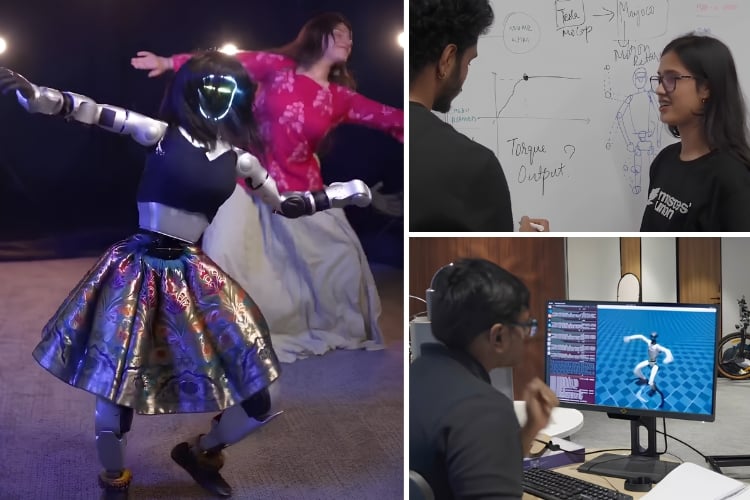
A humanoid robot named “Maya” has attracted attention in India after appearing on India's Got Latent, where it danced, rapped and interacted with people on stage. Maya is built on a Unitree G1 humanoid robot, but the Indian team behind the project added its own AI software, voice system, personality and custom movements. The team, associated with Tuesday Labs and students from Masters' Union, also transformed the G1's appearance with customized clothing, shoes, ornaments, a 3D-printed waist and a human-hair wig. Rather than developing a humanoid robot from the ground up, the project uses an existing robotic platform as the foundation and builds a new character and software experience around it.
The software behind Maya is particularly interesting because Tuesday Labs has released its voice and AI system as an open-source GitHub project. The repository describes Maya as the “voice and brain” for a Unitree G1 and is built primarily with Python and asyncio. Its pipeline starts with openWakeWord, which listens for the name “Maya.” Speech is then processed using Sherpa-ONNX with NVIDIA's Parakeet TDT CTC 110M model for speech recognition. The resulting text is passed to a Gemma-based small language model through Ollama, while ElevenLabs provides text-to-speech. The system communicates with the physical robot using unitree_sdk2py. The software also controls the G1's LEDs for listening, thinking and speaking states, triggers arm movements while Maya talks, and uses smooth motion interpolation to make those movements less abrupt.
Maya's physical movements add another layer to the project. The team has publicly demonstrated custom movements, including the “SIUUU” celebration, and has also shown Maya performing an Indian classical dance. In the team's description of the dance-training process, they say they first used motion capture to record the dancer's movements and then used reinforcement learning to train the robot to reproduce the performance. This is an important distinction from simply programming a fixed sequence of joint angles. Human motion has to be converted into movements that match the G1's own joint structure, limits and physical capabilities. In a typical reinforcement-learning motion-imitation workflow, the captured movement becomes a reference trajectory, a policy is trained to track that motion while satisfying stability and physical constraints, and the resulting policy can then be tested in simulation before being deployed on the real robot. Unitree itself provides public G1 reinforcement-learning and simulation tools that support training, simulation testing and sim-to-real deployment.
However, the exact training pipeline used by the Maya team has not been publicly released. The public Tuesday Labs repository currently focuses on Maya's voice, AI and high-level robot interaction rather than the dance-training system. It does not specify the exact reinforcement-learning algorithm, reward function, motion-capture hardware, simulation environment, motion-retargeting software or training hardware used for the classical-dance performance. Therefore, those details should not be attributed to Maya without confirmation from the team.

Add a comment
No account needed. Your comment appears once a moderator has reviewed it.