
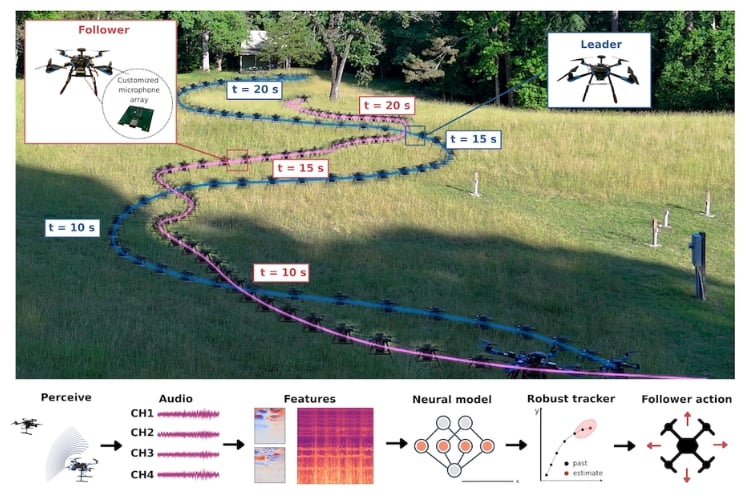
Researchers at Duke University's General Robotics Lab have built a system that lets one drone follow another using nothing but the sound of its rotors. The project, called SonicFly, estimates a leader drone's bearing and distance from onboard audio alone, without GPS sharing, cameras, radio links, or any active signal exchange between the two aircraft.
The core challenge is that the follower drone is itself a loud acoustic source. Its own propellers, motors, and airflow generate far more noise than the leader's signal by the time it reaches the microphones, especially outdoors where wind and distance further degrade the signal. To work around this, the team gave the leader drone two-blade propellers and the follower three-blade propellers. The mismatch produces distinct harmonic frequencies for each aircraft, making it easier for the follower to separate the leader's acoustic signature from its own noise.
The follower carries a custom four-microphone array, spaced 75mm apart, built around ICS-43434 MEMS microphones and synchronized through an ESP32-S3 microcontroller. Captured audio is converted into spectrograms along with interaural phase and level difference features, then processed by a neural network that estimates the leader's relative position. A confidence-gated Kalman filter smooths the output before it's handed to the flight controller.
In outdoor pursuit tests across varied weather and lighting conditions, the follower maintained an average distance error of 1.34 meters while tracking a leader at a target separation of 3.5 meters. Bearing estimates reached a mean error of about 31 degrees after filtering. Researchers also compared observability rates against vision and LiDAR sensors under degraded conditions, where the acoustic system outperformed both.
The paper, posted to arXiv on August 1 and not yet peer reviewed, frames the work as a complementary sensing method rather than a replacement for GPS or vision, useful in situations like GPS-denied environments, low visibility, or scenarios where drones cannot communicate.

Add a comment
No account needed. Your comment appears once a moderator has reviewed it.