

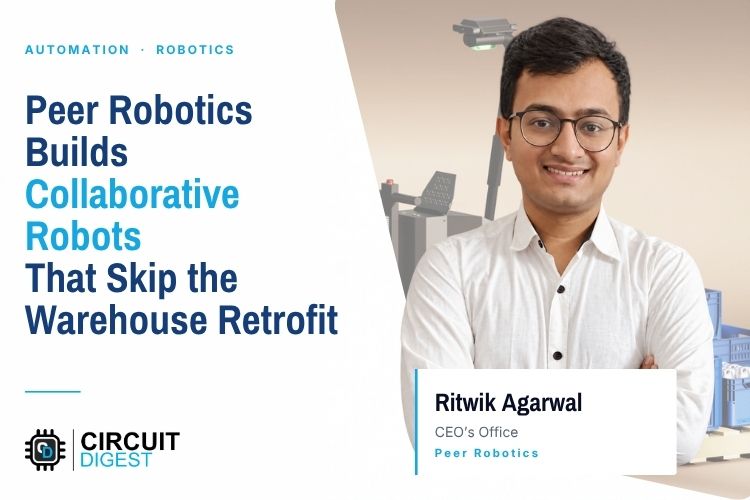
As part of our India Tech Tour series, we visited Peer Robotics' facility in Pune, where Ritwik walked us through the company's robots, manufacturing setup, and engineering processes. We also spoke with Ruchit, Vice President of Software Engineering at Peer Robotics, about the company's approach to deploying autonomous mobile robots in industrial environments.
This feature is part of our India Tech Tour series, presented in collaboration with DigiKey, a leading global distributor of electronic components serving engineers and innovators across 180+ countries with a catalog of over 17.4 million products from 3,000+ suppliers.
The Peer 3000
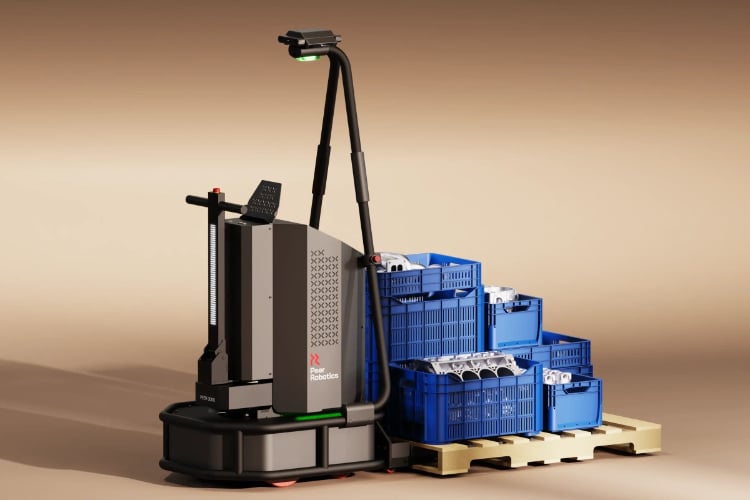
The Peer 3000 is a collaborative mobile robot designed to move pallets and other materials around industrial and warehouse environments. Its modular platform can accept different attachments for different material-handling tasks.
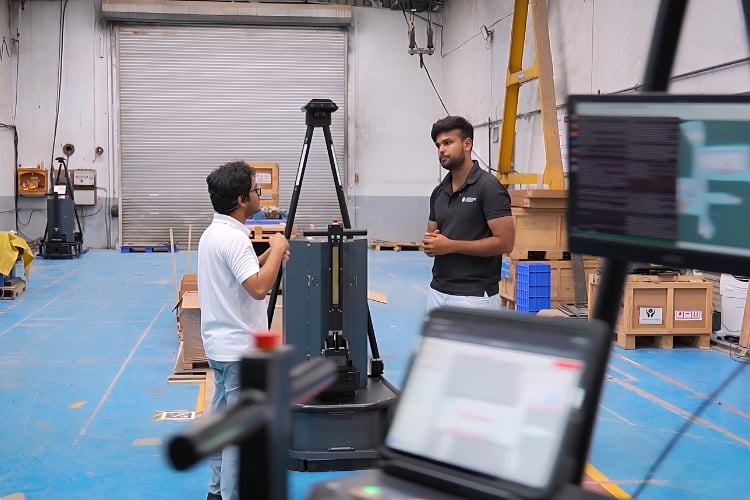
The version we saw was fitted with a pallet jack attachment that allows it to move underneath a pallet, lift it, and transport it elsewhere. Ritwik said the robot is intended to handle pallet movement across multiple stages of a facility, from unloading a trailer and moving goods into storage to taking them to end-of-line locations and loading them back onto a trailer. The same platform can also be configured to move carts and trolleys.
Navigation and Safety
The Peer 3000 uses a combination of cameras, 2D lidar, wheel encoders, and IMUs for navigation and localization. Ritwik described visual SLAM as the main approach, with the other sensors providing additional information that is combined through sensor fusion.
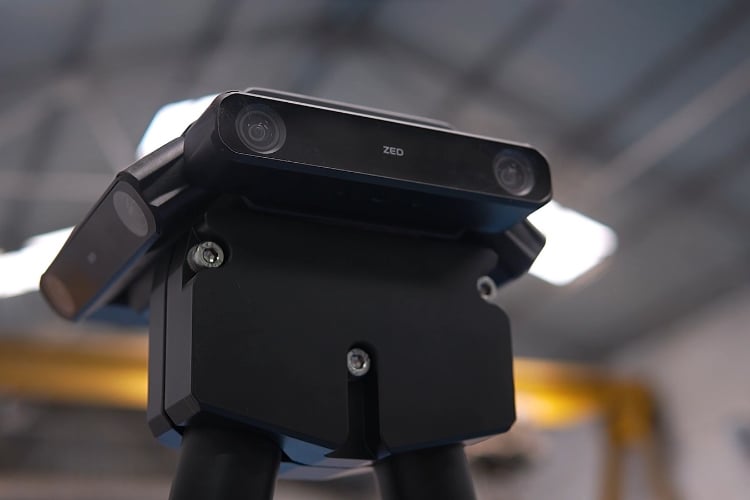
Safety is also handled at the hardware level. Ritwik pointed to an ultrasonic sensor that can stop the robot when an object enters its defined detection range, which he referred to as the "lethal zone." He said this safety layer operates independently of the software and is built to comply with ANSI/RIA R15.08 and UL ratings. He also mentioned that the company is pursuing additional certifications.
Edge Computing and Fleet Management
The robot handles its computing locally through an onboard NVIDIA board, which processes sensor data and runs the navigation and localization algorithms. Ritwik described Peer Robotics as a "physical AI company" in this context, with the onboard cameras and computing allowing the robot to understand its surroundings.
Some additional capabilities are still under development. One example discussed during the visit was a 3D map that could potentially identify misplaced items or bottlenecks. This work is currently being handled by the R&D team and is not yet deployed in production.
For facilities running multiple robots, an on-premises fleet manager coordinates their movement. Each robot reports its position and destination so the system can manage traffic between them. The robots operate over the facility's local Wi-Fi and do not require an internet connection unless a customer specifically wants one.
From Deployment to Production
The robots are designed for around eight hours of runtime, according to Ritwik, with autonomous charging allowing them to return to a charger when their battery falls below a set threshold. He estimated a full charge at roughly one and a half to two hours.
Deployment begins by studying the customer's existing operations and mapping the facility. Missions are then defined around specific pick-and-drop points, followed by a proof of concept with engineers on-site.
Ruchit said simpler environments can be deployed in about a month, while more complex facilities can take three to four months. He also said the robots do not require site-specific training beforehand and can operate "out of the box," with further learning taking place as operational data is collected.
The Market and the Reliability Challenge
The business case for the robots varies by market. Ruchit said higher labor costs in the U.S. and Europe make the return on investment easier to justify, while lower labor costs in India make the economics more difficult except for high-volume, high-reliability applications.
He estimated that roughly 70 to 80% of the company's current commercial activity is in the U.S., with around 20% in Europe and 10% associated with older deployments in India.
Reliability is a major engineering concern for industrial deployments. Ruchit said Peer Robotics runs robots continuously for months at its own facilities in Detroit and Pune to identify hardware and software problems before they reach customers. He estimated that a full redesign could take three to six months, while hardware patches can take about a week. Software patches can take anywhere from a few hours to several weeks depending on their scope.
What's Next
Peer Robotics has finished building out its current robot and is now moving into a sales-focused phase, Ruchit said. Over the longer term, the company wants to automate truck loading and unloading with minimal human involvement. The eventual goal is what was described as "lights out" operation, where robots can continue working without people present or the lights on.

Add a comment
No account needed. Your comment appears once a moderator has reviewed it.