
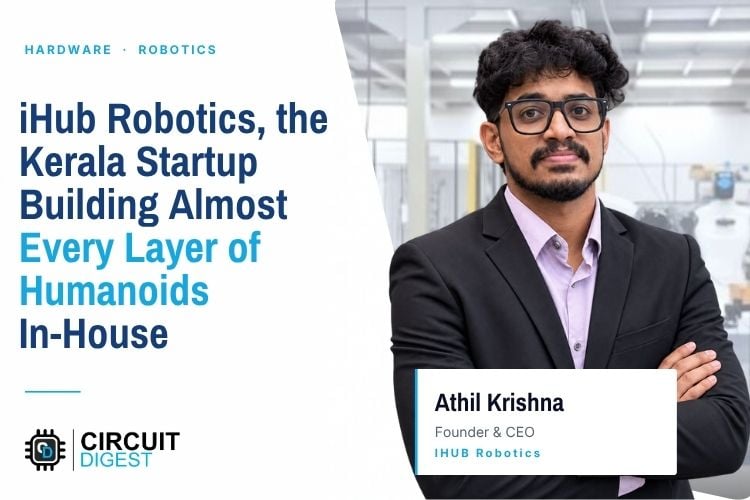
Athil said his interest in robotics began during his school years, inspired partly by the Tamil film Enthiran and partly by Iron Man. He said he wanted to build his own version of that kind of technology. During that period, Arduino boards were difficult to get, so he started building small robots from whatever components were available.
One of his robots went viral in a video during that time, which led a scientist based in Delhi to connect with him and invite him to participate in the India International Science Festival, held in 2016. He said he built another robot for the demonstration and received a Best Innovation Award there.
Following that, he pursued a vocational higher secondary background in technology and decided to study mechatronics engineering. In 2017, he joined Akshaya College of Engineering and Technology in Coimbatore. His classmate there, Akhil K. Haridasan, would become his co-founder. Sarath S., described as a senior mechatronics engineer with the same interest, joined as the third co-founder.
This feature is part of our India Tech Tour series, presented in collaboration with DigiKey, a leading global distributor of electronic components serving engineers and innovators across 180+ countries with a catalog of over 18 million products from 3,000+ suppliers.
Stalled by Covid
The team started their first company in 2018. Athil said the ecosystem for robotics in India was not developed at that time, and while the team received recognition and awards for their prototypes, they struggled to secure funding. He said they had developed 50 to 60 prototypes before starting the company, working with limited resources and self-taught programming on Arduino and similar platforms.
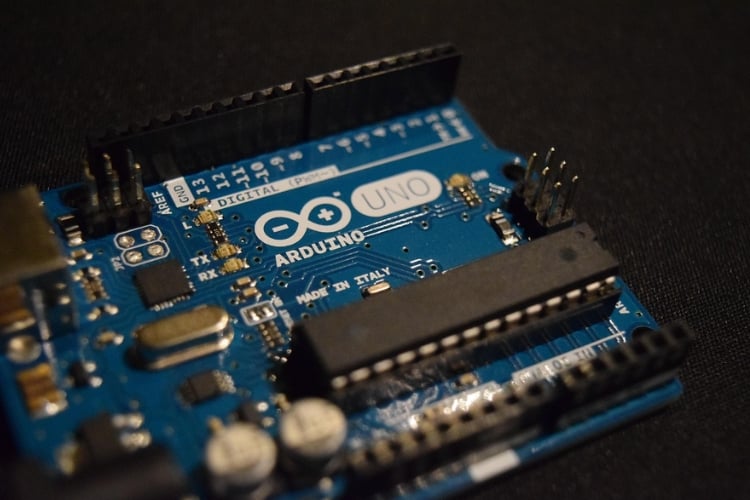
He said the team applied for several government grants without success, and eventually reached out to the Prime Minister's Office directly, describing their proposal as a defence project. About six months later, in 2020, they received a response saying the project had been forwarded to the Border Security Force (BSF), which expressed interest in seeing a prototype. The Covid-19 pandemic disrupted these plans. With no working prototype ready and having returned to their native place in Kerala, they were unable to present a demonstration.
During the pandemic, one of the co-founders pursued an MTech in robotics at Amrita. Athil said the team realised their earlier approach to building robots had been incomplete, and in 2022, with new knowledge, they restarted the company as iHub Robotics.
Tara and the UAE Deployment
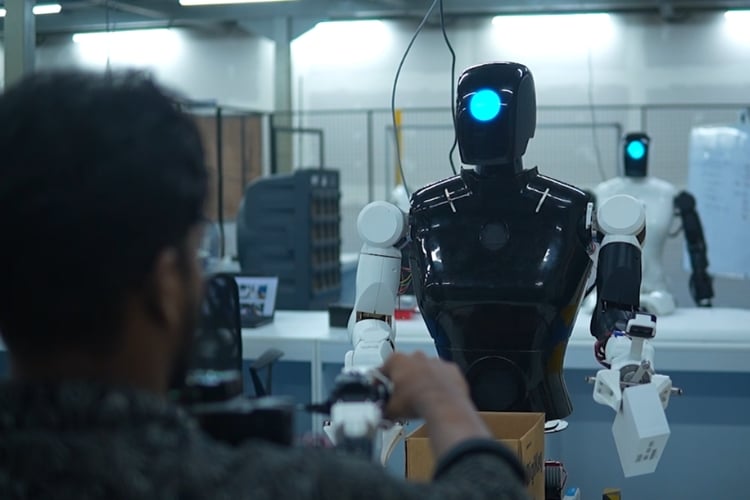
The company's first product was Tara Generation 1, a service robot. Athil said the team built around 64 prototypes before arriving at a version they considered ready for deployment. Early clients included Amrita and an institution he referred to as Nehru University, where Tara was deployed as a reception-purpose robot.
The company then received an inquiry from the UAE government, which was looking for a vendor that could store data locally rather than relying on cloud infrastructure, a requirement that ruled out some vendors they had already evaluated. iHub Robotics deployed seven Tara robots for the UAE government, built to interact fully in Arabic, including handling government service tasks such as helping visitors apply for solar energy loans, and returning automatically to a charging dock when battery levels dropped.
He said the biggest technical challenge in that deployment was voice delay, since converting Arabic speech to text, processing it through a language model, and converting the response back to speech initially took 10 to 12 seconds. The company built its own models to reduce this delay to a voice-to-voice system.
According to Athil, iHub Robotics deployed 35 Tara robots across India, the UAE and Saudi Arabia by the end of the previous year, and around 30 more in the first quarter of this year.
Daksha and Industrial Clients
After Tara, the company began developing Daksha, aimed at industrial applications. Athil described feedback from clients including a company that manufactures drums, where manual error-checking took five to six minutes per unit; he said the company's humanoid could complete the same check in 35 seconds with what he described as 95% accuracy. He also referenced a battery-handling task at another plant involving a 30 kg component on an assembly line.
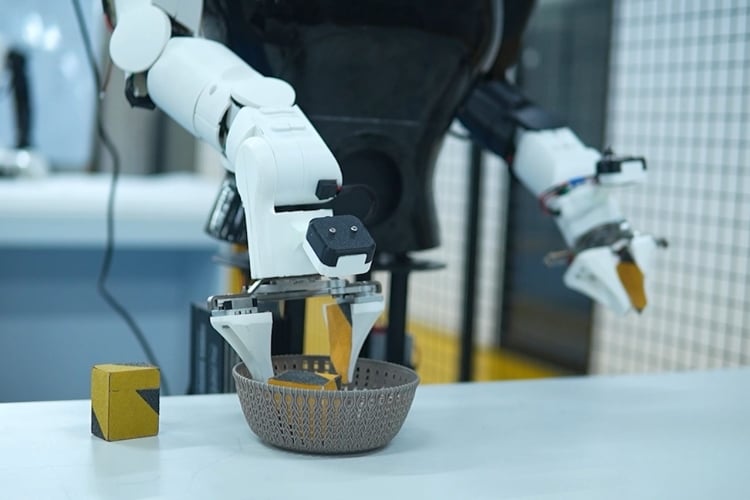
He said the company received an inquiry in March 2025 from an automobile manufacturer he described as one of the largest in the world, with around 155 plants globally, which he did not name due to confidentiality. The task required a robot to handle a 4 kg payload with precision, which pushed the company to develop what it calls a vision-language-action (VLA) system, since existing Tara-generation technology was not built for that level of precision. The company said it used Aruco markers as a first step for perception before further developing its systems.
According to Athil, the company's first industrial client was SAP, following interest from Sindhu Gangadharan, Managing Director of SAP Labs India, who saw a demonstration at a NASSCOM event in Bangalore. iHub Robotics has since signed an agreement with SAP and is deploying Daksha robots for SAP's living labs.
Athil said the company launched Daksha at the India AI Impact Summit, and has since received orders from Indian and international companies, including a large Indian consumer company for which it is building a factory involving robot-to-robot communication.
Later in the conversation, Athil put the total Tara Generation 1 deployments at around 62 to 63 units, and said the company is manufacturing 10 to 20 robots a month, with production increasingly focused on Daksha. He said the company shipped its first humanoids to a government organisation in the UAE in 2023 and was preparing to ship its first batch of humanoids to the United States.
Product Lineup
Athil described the company's product lines this way. Tara is the service robot, with variants including Tara Greet for office use, Tara Learn, a teaching robot capable of explaining multiple subjects, and Tara Care. Daksha is the industrial humanoid. Karma, also referred to as Karna in parts of the conversation, is the third-generation bipedal humanoid. Astra is a robotic arm sold to Indian clients and, as of the interview, being shipped to the United States. K9 is a quadruped robot that the company deployed the week before the interview.
Technology and Supply Chain
Athil said the company builds most of its hardware and software in-house, including embedded systems, battery management, and body structures, while procuring around 28 to 30% of components from Japan, Taiwan and China. He said the company depends on Nvidia for its main compute architecture, including Jetson boards, and said iHub Robotics was the first company selected for Nvidia's humanoid robotics program in 2023, giving it early access to tools including Isaac Sim and Cosmos.
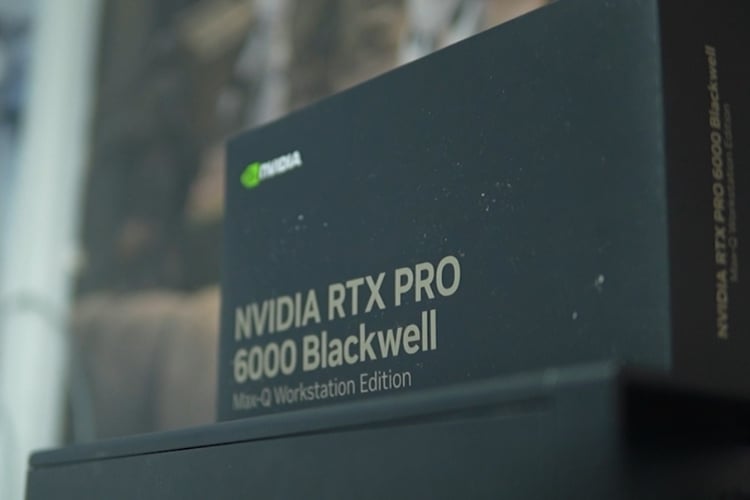
He described the company's progression through Nvidia hardware, from early Jetson boards to the Jetson AGX, which he said offers 278 trillion operations per second, and said this was still insufficient to run large foundation models such as a 104-billion-parameter model from Physical Intelligence. In response, the company built its own model, which Athil referred to as the Viveka Decision Core system (also mentioned as "Bibeka" during the conversation), a 3.3-billion-parameter vision-language-action model built on a mixture-of-experts architecture with seven expert modules. He said the company's onboard hardware can run at 2,000 trillion operations per second, and that reasoning currently takes about seven seconds per task.
The company developed what it described as a three-layer VLA system, combining perception, a "system one and system two" processing structure, and a safety and feedback loop that adjusts for hardware errors during a task.
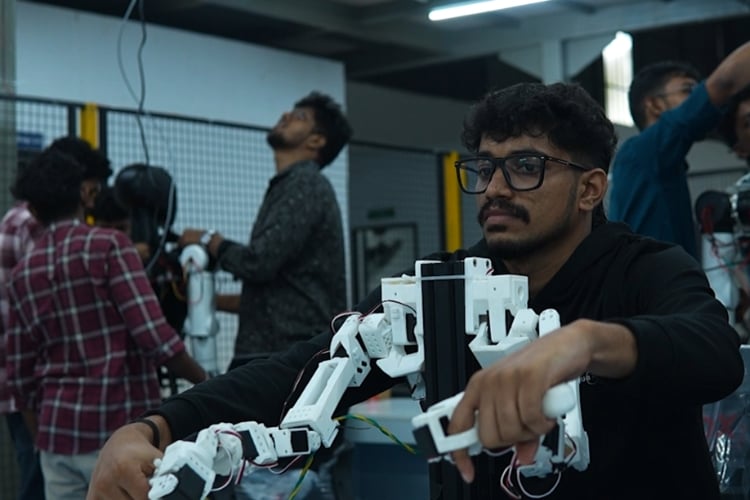
Training a robot to perform a task typically requires 20,000 to 40,000 examples, Athil said, but the company's optimised models can achieve higher accuracy using around 2,000 to 3,000 examples. He described "ecocentric data," referring to training data specific to a given environment's lighting, temperature and layout, as necessary because variation in these conditions can cause the system to hallucinate.
Athil also discussed a longer-term plan to develop the company's own processor by around 2030 to 2031, aimed at running larger models on edge devices for what he described as "physical AGI." He said early prototyping had begun with support from companies in Taiwan and that some prototypes had already been developed, though he described this as a long-term project distinct from the company's near-term roadmap. He mentioned Kerala-based chip company NetraSemi and Chennai-based Mindgrove as other Indian companies working on chips, though not specifically for robotics in his description.
On sourcing components more broadly, Athil said DigiKey has been a useful platform given the difficulty of finding critical robotics parts within India, since the country currently lacks the domestic supply chain to reliably source them. He said the company has achieved around 70% indigenous development of its robots by his estimate, with a goal of reaching 92% within two years.
Funding and Business Model
Athil described iHub Robotics as a bootstrapped company since 2022, later raising a small funding round from US-based angels. In 2024, the company said it closed an investment of 4.5 crore (about $520,000) from a US investor. He said the company operates on a model where a significant share of revenue is reinvested into its in-house research and development lab, rather than prioritising profit.
He said the company built its current facility, referred to as its Gigafactory, around eight months before the interview to support training its robots at scale, following the 2024 funding round.
Athil described the company as having reached break-even, while noting that competing with larger funded companies remains a challenge. He said the company employs 75 people across four offices, two in Kerala, one in Karnataka, and one in Tamil Nadu, in addition to a presence in the UAE, with around 32 people working in its deep tech lab.
He referenced Figure, a US humanoid robotics company he said is valued at 42 billion US dollars, as a point of comparison for how much the market can grow. He also referenced Boston Dynamics, Unitree and Neura Robotics as other companies working on similar categories of humanoid technology.
Future Plans
Athil said the company's five-year plan includes listing on the Indian stock market by 2031, developing more powerful humanoids, and deploying robots for Indian defence applications. He also referenced a plan to deploy robots on the moon in collaboration with InSpace and ISRO.
He said the company had been offered an opportunity to relocate its operations to the UAE with a significant investment but chose to remain in India, citing a broader goal of building indigenous research and development capacity in critical technologies. He said some government organisations in India currently use robots from Chinese companies, which he said means data from those deployments is stored in China, and that iHub Robotics wants to offer an alternative that keeps data within the country, including a longer-term goal of deploying robots along the Line of Control.
Asked to close the conversation, Athil said he sees robotics and physical AI as a major and still uncertain technology area, noting that if India does not develop the capability, it will remain dependent on other countries for a technology he expects will affect many sectors, including hospitals, warehouses, logistics, industry and schools over time.

Add a comment
No account needed. Your comment appears once a moderator has reviewed it.