

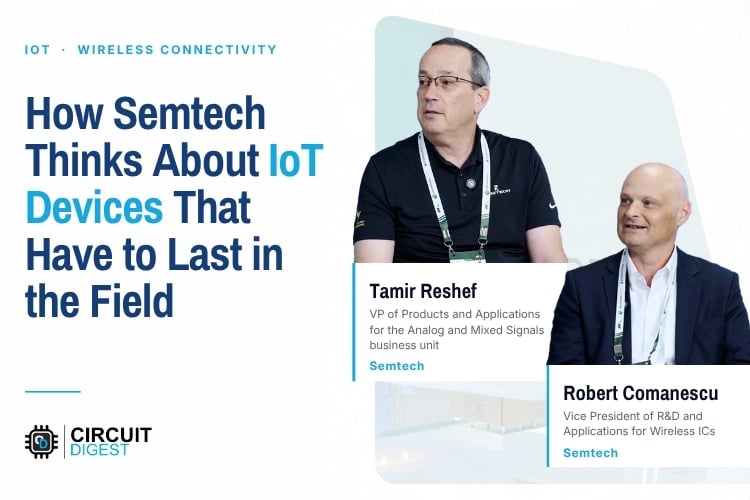
Semtech’s Robert Comanescu, Vice President of R&D and Applications for Wireless ICs, and Tamir Reshef, Vice President of Products and Applications for the Analog and Mixed Signals business unit, discussed the challenges of building IoT devices that communicate reliably and withstand real-world conditions at electronica India and productronica India 2026 in Bengaluru.
About the event
This conversation was recorded at electronica India and productronica India 2026, South Asia's leading trade fair for the electronics industry. Held September 16-18 at the Bangalore International Exhibition Centre in Bengaluru and organized by Messe Muenchen India, the show covered the full electronics value chain, from components and design to manufacturing. It brought together 793 exhibitors and over 52,000 business visitors under the theme "India's Powerplay in Electronics."
Connectivity: From Long Range to Multi-Protocol
Robert Comanescu, who joined Semtech 26 years ago in RF IC design and now leads its wireless marketing organization, said LoRa began with long range and the ability to get through concrete. The first use case was metering, where a buried water meter has to reach a gateway on top of a building. From there it spread to city sensors such as environmental monitoring and traffic light control, then to asset tracking, the home, and even flying devices, which he said will underpin the low altitude economy.
Because all these devices need updates, Semtech has added a companion technology on top of LoRa that keeps similar performance but reaches up to 2.6 megabits per second. Comanescu said the company is also moving beyond LoRa and FSK toward multi-protocol support, since customers find it hard to choose between two protocols. Backward compatibility with an earlier technology plus the benefits of a newer one makes that choice easier. In his view there is no single winning protocol, and the real value for customers is the security of connectivity.
His example was smart home security. Sensors may talk over Z-Wave to a central unit that reaches the cloud over Wi-Fi. If the Wi-Fi drops or the user changes the password, the company has to send someone to the house. A back channel the user cannot interfere with would let the company re-secure the link remotely.
Scaling and Edge AI
For companies scaling from prototype to many devices, Comanescu recommended a proven technology that comes with software deliverables, so there are fewer iterations. Interference immunity matters too: the 2.4 GHz band, for instance, is crowded with BLE, Wi-Fi and other signals.
On edge AI, he said processing used to sit mostly in the cloud, which meant sending big chunks of data and draining the device. Now the device analyzes data itself and sends just the alarm, which suits LoRa. But proof may still be needed. If a window breaks, the device can detect the sound and decide on its own, yet still has to get a picture to the cloud. That takes a very long range, robust link for the alarm and a way to deliver the processed data within a limited time. He called edge AI early-stage but a strong tailwind for Semtech.
He said LoRa fits because of its power efficiency, range and immunity to interference, and because it is a mature protocol that doesn’t keep changing the way cellular has from 2G to 3G to 4G. A network can be deployed at low cost with only a few gateways in a neighborhood, and the operator stays in control for a long time.
Protection: The Last-Mile Problem
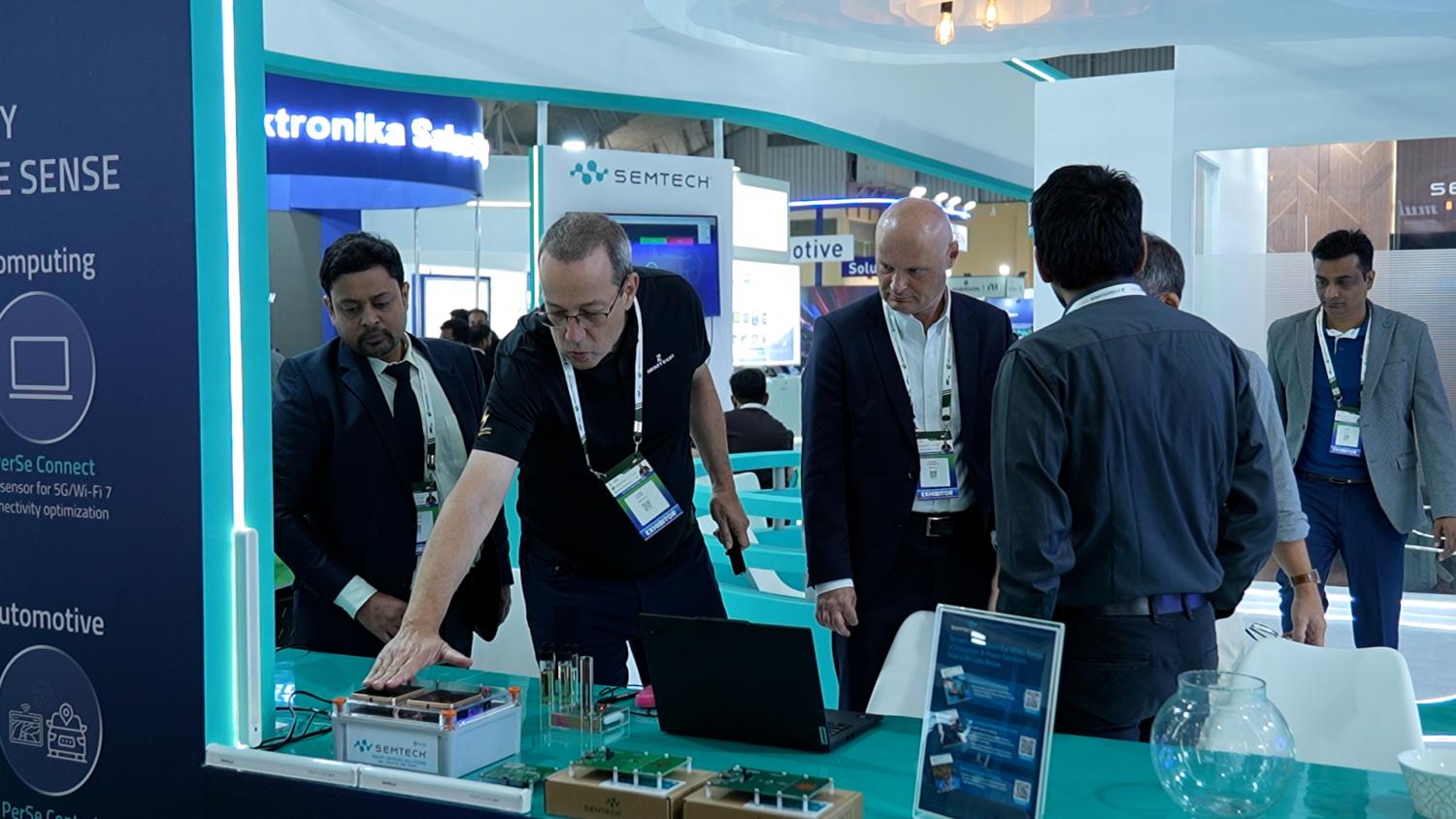
Tamir Reshef, who oversees product definition for Semtech’s sensing and ESD protection lines, said protection started in smartphones, where high-speed buses need protecting so devices keep working. Space matters because every square millimeter saved gives the user more battery life. He compared protection to insurance: if the electronics in a smart home device that lets people in are fried, someone can be stuck outside.
The thing engineers most often miss, he said, is ESD. Designers focus on the product, then it fails in the certification lab, so protection becomes a last-mile effort. More experienced companies build in provisions so they can add protection later.
Some customers also don’t want a sensor to be reprogrammable once deployed, so a hacker can’t get in and lock people out. Reshef described offering manufacturers a memory that can be flashed only during manufacturing, where readout and calibration also happen. After that, the device can no longer be communicated with.
He agreed that more functions mean more protection, and gave a car remote as an example. The remote now works from a distance, and when its battery is changed more often, people touch the terminals. A discharge can jump to the long-range antenna and fry it.
Smart Sensing and Wearables
Reshef described “smart human sensing,” where the sensor decides on its own what it’s detecting. A fingerprint sensor used for a government ID, for example, could tell a real hand from a fake print without sending data to the cloud, saving power and keeping the decision local. He said the same applies in cars, where a European regulation covers detecting a child in the back seat. He expects it to reach China and India, and sensors are being asked to tell whether something is human and what size, which could also inform airbag deployment.
On sensing and protection interacting, he described a large smartphone maker in China whose sensor was connected to the antenna. A lightning strike could couple into the antenna and destroy the sensor, while the wrong protection would degrade the signal and cause false sensing. Semtech built a reference design that solves both, and he said he sees it in mass-market smartphones.
Wearables surprised him most. In a vibrating car, people miss keys, and with smart glasses you can’t see where you’re pressing. With capacitive sensing alone, wet hair could turn the glasses’ camera on. Hair dryers, heat, cold, sunscreen and makeup are things engineers rarely consider at design time. Semtech’s answer is sensor fusion: capacitive sensing sees a finger approaching, but only force confirms a real press. That also saves battery, since the microcontroller and capacitive sensing stay off until force is applied, so hair or a towel won’t wake them. He also pointed to water ejection as a big topic, with people using devices while jogging, swimming and showering, and said wearables could bring health monitoring to people without doctors, such as in a rural Indian village.
India and What’s Next
Comanescu said metering is seeing heavy investment in India, with street lighting among the first connected-space uses, gated communities adopting LoRa because deployment is easy, and asset management devices starting to appear. He said the ecosystem is building, with devices and now modules showing up, so the whole supply chain is starting to be present. Reshef said Semtech’s India journey began two to three years ago and design, application work and support are now done directly from India, with a strong two-wheeler community starting to move toward four-wheelers.
Looking ahead, Comanescu said each wireless generation must beat the last on robustness, range and power, since some devices stay in the field fifteen years or more. Reshef expects protection to be driven by size and speed, with elements small enough to fit yet low in capacitance so they don’t degrade the signal. In sensing, he expects smarter detection that separates a wanted event from a false trigger, building on early SAR sensing in phones, which lowers transmit power near the head and allows full power otherwise.

Add a comment
No account needed. Your comment appears once a moderator has reviewed it.