
Electronic is fun to learn, especially if you can learn it by building your own circuits. To help you with that, Circuit Digest provides you with a list of popular Electronic circuits and Electronic projects with well illustrated circuit diagram and detailed explanation for a complete do-it-yourself experience. All projects are tested and verified with a working video for a hassle free learning experience. Whether you are an expert or beginner in electronics, we have something interesting for all of you. Below is our huge collection of 200+ free electronic circuits that you can build today.

Solenoids are very commonly used actuators in many process automation systems. There are many types of solenoids. For instance, there are solenoid valves which can be used to open or close water or gas pipelines, and there are solenoid plungers which are used to produce linear motion. One very common application of a solenoid that most of us would have come across is the…

In the previous tutorial, we demonstrated detailed design of Boost Converter using MC34063, where a 3.7V to 5V boost converter was designed. Here we see how to convert 12V to 5V. As we know that exact 5V batteries are not always available, and sometimes we need higher voltage and lower voltage at the same time to drive different parts of circuit, so we use higher voltage (…

Different Electronic systems operate in different level of voltages. Most commonly the digital electronic systems like microcontrollers and microprocessors operate in 5V or 3.3V. Industrial Level Control devices like PLC, HMI etc. have an operating voltage of 12V, 24V etc. The loads (LED indicator) and sensors, that are used to interface with a PLC, also have a nominal…

In modern days, Lithium batteries are enriching the electronics world. They can be charged very fast and provide good backup, which along with their low manufacturing cost makes lithium batteries the most preferable choice for portable devices. As a single cell lithium battery voltage range from minimum 3.2 voltage to 4.2V, it’s difficult to power those…

The reliability of any electronic device depends on how well the hardware protection circuits have been designed. The end user (consumer) is prone to make mistakes, and it is the responsibility of a good hardware designer to protect his hardware from any mishap. There are ample types of protection circuits, each with its own specific applications. The most common type of…

Operational Amplifiers (Opamp) has so many interesting applications, and we have already created many circuits using op-amps. Today we are going to study one more application of Opamp which is to add two or more input voltages and the circuit is called Summing amplifier or Opamp Adder. Here we will use LM358 Opamp to demonstrate the Adder Circuit.
…

With the boom of Smart Phones, Internet of things (IoT), Industrial Automations, Smart Home Automation systems etc. the demand for internet is also growing exponentially. The technology has evolved so much that everything from our car to our refrigerator needs a connection to the internet. This raises other questions like; Will there be enough bandwidth for all…
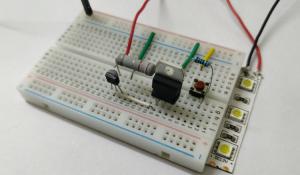
Fuse is a vital protection device for many electronic devices. They simply monitor the current consumed by the circuit/load and in the event of unsafe current flowing through the circuit the fuse will blow itself and thus prevent the load/circuit form getting damaged by that high current. This type of fuse is called a mechanical fuse and there are many types of fuse such as…

From the past few years the demand of low power electronic portable devices has been increased rapidly. And there are very limited options to power these small portable electronic devices like alkaline batteries or solar power etc. So here we are using a different method to generate small amount of power which uses Piezoelectric sensor. Here we will build…

Sometimes when we reach home in the night it’s hard to unlock the door lock, as we are not able to find the keyhole because of darkness. So, to get rid of this problem there are many keyhole lighting devices are available in the market. But we can also make one easily, using LDR. Here, we are going to control the key-hole light automatically based on the darkness outside,…
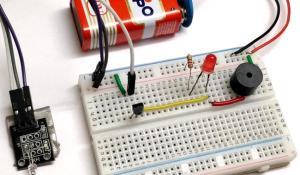
A tilt sensor is a sensor which opens and closes an electrical circuit when it is inclined beyond at certain angle. It can be used in tilt prevention devices, an alarm circuit and in many DIY projects. There are different types of Tilt sensor modules, for sensing the tilt the module can have a ball switch or mercury switch. In this circuit, we are using a Mercury-based tilt…
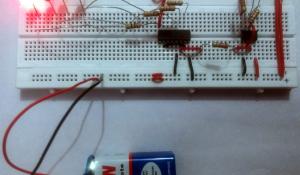
In a general way, the Cable Tester is the device by which we can check whether the cable has defected or it is connected in a proper way. A cable tester is the very useful way to determine the physical quality or connectivity of the cable or wires individually while installing them. It detects whether the cable is connected properly and the communicative strength between the…