
Electronic is fun to learn, especially if you can learn it by building your own circuits. To help you with that, Circuit Digest provides you with a list of popular Electronic circuits and Electronic projects with well illustrated circuit diagram and detailed explanation for a complete do-it-yourself experience. All projects are tested and verified with a working video for a hassle free learning experience. Whether you are an expert or beginner in electronics, we have something interesting for all of you. Below is our huge collection of 200+ free electronic circuits that you can build today.

A Power supply unit is a very commonly used tool by most engineers during the development stage. I personally use it a lot when experimenting with my circuit designs on Breadboard or to power up a simple module. Most of the digital circuits or embedded circuits have a standard operating voltage of either 5V or 3.3V, so I decided to build a Power supply which can supply 5V/3.…

Protection circuits, like reverse polarity protection, short-circuit protection, and over/under voltage protection, are used to protect any electronic appliance or circuit from any sudden mishap. Generally fuse or MCB is used for overvoltage protection. Here in this circuit, we will build a simple overvoltage protection circuit without using a fuse.
…
One of the cool projects I always wanted to build is an FM transmitter with a good range. I have always been fascinated by some of the applications of the transmitter, especially when I was younger and, like everyone else, spent most of my time imagining how cool it would be to have some of the equipment and devices used in spy movies. So recently, while going over one of my…
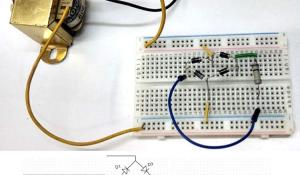
The process of converting alternating current into direct current is rectification. Any offline power supply unit has the circuit for rectification which converts either the AC wall supply into a high voltage DC or stepped down AC wall supply into low voltage DC. The further process will be filtering, DC-DC conversion and etc. So, in this article we are going to discuss…

We have limited natural resources and that too we are using in generating Electricity. That’s why there is lot of emphasis is given on generating and using clean energy. Today in this project, we will see how electricity can be generated from the sunlight, how it can be stored in the form of DC, and then how it is converted into AC to drive home appliances.
…
We have previously created a complete and detailed tutorial on Phase Shift Oscillator. Here we will see practical implementation of phase shift oscillator. In this project, we create phase shift oscillator circuit on breadboard and test its output using oscilloscope.
What is Phase and Phase Shift?
Phase is a full…

Short circuit protection is an unintended connection between two terminals which are supplying power to the load. It can happen both in an AC and a DC circuit. If it is an AC supply, then a short circuit can trip the power supply of the whole area, but there are fuses and overload protection circuits at many levels, from the power station to the house. And if it is a DC…

Batteries are most convenient power source to supply voltage to an electronic circuit. There are many other ways, to power up electronic devices, like adapter, solar cell etc but the most common DC power supply is Battery. Generally all the devices come with Reverse Polarity Protection Circuit but if you have any battery operated device which don’t have reverse polarity…

Sample and Hold Circuit takes samples from the analog input signal and hold them for particular period of time and then outputs the sampled part of input signal. This circuit is only useful for sampling few microseconds of input signal.
A Sample and Hold circuit consist of switching devices, capacitor and an operational amplifier. Capacitor is the…

Circuit schematics are crucial for electronics engineers to understand. For the majority of real-world applications, Class A amplifiers offer the lowest distortion, Class B amplifiers the most efficiency, and Class AB amplifiers the best resolution. The particular needs for power, distortion, and efficiency will determine the choice.
A push-pull…

Voltage Regulator, as the name suggests, is a circuit that is used to regulate the voltage. Regulated voltage is a smooth supply of voltage, free from any noise or disturbance. The output from the voltage regulator is independent of load current, temperature, and AC line variation. Engineers can create reliable power supply systems with the aid of these voltage…

Voltage Follower is simply a circuit in which output follows the input, means output voltage remains same as input voltage. It is also commonly known as Unity gain Opamp Amplifier or Opamp Buffer. Here we construct a voltage follower using Opamp LM741 and see how its output follows the input. We already discussed about it in our Non-inverting Operational Amplifier tutorial,…