

Axiometa, a Lithuania-based open-source hardware team, is introducing BreadBoost-C, a compact USB Type-C-powered solution for breadboard prototyping. Designed for makers, educators, and engineers, BreadBoost-C simplifies circuit prototyping by eliminating messy wiring and bulky bench power supplies.
The device offers adjustable…
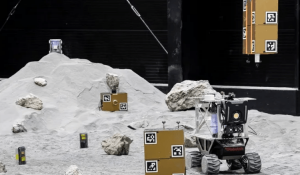
What if robots could guide each other during an expedition on the Moon? A new system called Swarm Navigation Network made by a group of German (DLR) scientists is making this a reality by simplifying the communication by networking up to 50 robots and sensors.
Each team member, whether a robot or sensor, shares information with…

Wireless power transfer is not a new term nowadays. Many of us have been using it for the past few years to charge up our smart devices. But all of the commercially available solutions are based on magnetic coupling, ie even though it's wireless power transmission, the transmitter and receiver need to be in very close proximity. There are studies on microwave-based wireless power transmission…
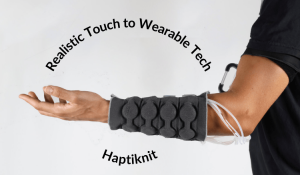
Human touch is the most intuitive way to communicate, but recreating it perfectly without being bulky was challenging for engineers. Haptiknit, a flexible sleeve designed to give touch-based feedback (haptic feedback) to its users, is a next step towards this goal. This device can make virtual reality more real, help in physical rehabilitation, and allow…

For fans of Pokémon and DIY electronics, Kiara from Kiara's Workshop has created something that bridges nostalgia and maker ingenuity: functional Pokéballs that light up, open, and even simulate throwing mechanics. Taking feedback from her earlier design, she improved durability with reinforced resin lids, repositioned the button for better accessibility, and integrated a compact DFPlayer Mini…

Meet Tillu, a 3D-printed robot created by Mukesh Sankhla on his YouTube channel MakerBrains. This DIY Robot is a perfect blend of hardware and software, designed to be an awesome learning tool for anyone interested in learning robotics.
Powered by the Unihiker board, Tillu uses servo motors to perform all kinds of fun moves like…

In the future, AI robots will look like us and even take up tasks and complete them with incredible precision and efficiency. Now with new AI-powered humanoid robots in the market, this future seems rather near. The new Figure 02 is normalizing the integration of AI robotics in the manufacturing field and extending it beyond that. These machines are trained and are…

We’ve seen LCDs with touch input before, but what if the LCD itself could be used as a touch sensor? That’s exactly what YouTuber CNLohr has accomplished with his latest project, combining a 7-segment LCD, USB functionality, and touch sensing—all powered by the ultra-affordable CH32V003 RISC-V microcontroller, AKA "The $0.10 RISC V microcontroller". The CH32V003 doesn’t natively support USB,…

Ventiva, a tech startup, has introduced a new type of cooling technology known as the Ionic Cooling Engine (ICE). This solid-state cooling solution promises to revolutionize the cooling in electronic devices by eliminating the need for traditional fans, keeping it quieter and more efficient at the same time.
This new Ionic…
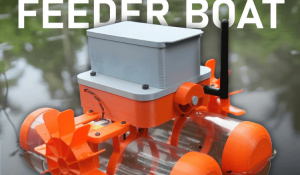
Imagine the joy of riding a remote-controlled paddleboat in the waters when we were kids. Gokul, a hardware designer and a 3D printing enthusiast, gave it a small twist by adding a few features, making it both a fish feeder and a delivery system for bait. And also as a medicine delivery system to hard-to-reach water filled places. This project turns a simple idea…
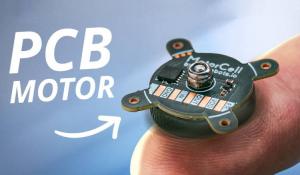
Carl Bugeja, a maker well-known in the DIY community for pushing the boundaries of PCB-based motors, has released his new PCB motor design, which is capable of surviving over 1.6 billion rotations. Built on years of prototyping and testing, this latest iteration combines efficiency, compactness, and durability, all within a printed circuit board design. What started as a rudimentary experiment…

A team of engineers at We Make Machines YouTube Channel has built a self-balancing bicycle with an aim to increase bicycle safety and eliminate human errors. Even though the project has made the cycle bulky and not being able to make turns it is interesting to see how self balancing is achieved using gyroscopic stabilization and learn about the potential problems…