
current

|
Simple Constant Current Generator using Transistor Many of us who have worked with Analog circuits would have often come across the terms voltage source and current source in a circuit design. While anything that provides a constant voltage like a simple 5V USB output or a 12V adapter can be considered as a voltage source, the term current source always seems to remain a mystery. And many circuits, especially the one… |

|
Howland Current Pump Circuit The simple current source is not perfect for variable loads as the current through load also changes with the load resistance. The solution for this problem is a Constant current source like Howland Current Pump Circuit. The Howland Current Pump was invented in 1962 by Professor Bradford Howland from MIT. It consists of an operational amplifier IC… |

|
Arduino Sleep Modes and How to use them to Save the Power Power consumption is a critical issue for a device running continuously for a long time without being turned off. So to overcome this problem, almost every controller comes with an Arduino sleep mode, which helps developers to design electronic gadgets for optimal power consumption. Sleep mode puts the device in power-saving mode by turning off the unused module. Whether you… |

|
Schottky Diode – Characteristics, Parameters and Applications A diode is one of the basic components that are commonly used in electronic circuit designs; it can be commonly found in rectifiers, clippers, clampers and many other commonly used circuits. It is a two-terminal semiconductor device that allows the current flow in only one direction, that is, from Anode to Cathode (+ to -) and blocks the current flow in the reverse direction… |

|
How to Measure Current with an Oscilloscope Measuring current is a simple task – all you need to do is hook up a multimeter to the circuit you want to measure and the meter gives you a clean value to use. Sometimes you can’t really ‘open up’ the circuit to put a multimeter in series with what you want to measure. This is solved quite simply too – you just need to measure the voltage across a known resistance in the… |

|
Understanding Maxwell Equations Maxwell equations are the fundamentals of Electromagnetic theory, which constitutes a set of four equations relating the electric and magnetic fields. Instead of listing out the mathematical representation of Maxwell equations, we will focus on what is the actual significance of those equations in this article. The Maxwell’s First and Second equation deals with static… |

|
4-20mA Current Loop Tester using Op-Amp as Voltage to Current Converter Sensors are an integral part of any measurement system as they help in converting the real world parameters into electronic signals that could be understood by machines. In an industrial environment, the commonly used type of sensors is the Analog Sensor and Digital sensors. Digital sensors communicates with 0’s and 1’s following protocols like USART, I2C, SPI etc. And… |
|
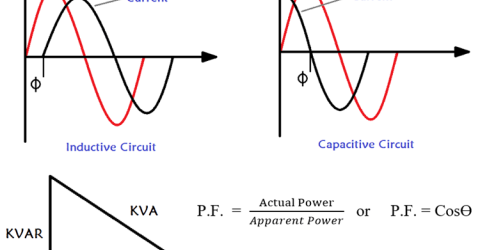
Understanding Power Factor and How It Affects your Energy Bills Aside from safety and reliability, several other goals including efficiency should be pursued in the design and implementation of electrical systems. One of the measures of efficiency in an electrical system is the efficiency with which the system transforms the energy it receives into useful work. This efficiency is indicated by a component of electrical systems known as… |
|
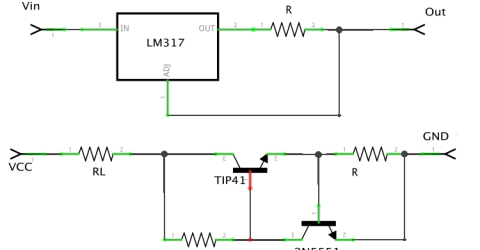
Current Regulators: Construction, Working and Design Types Just like situations in which we need to regulate the voltage in our designs, there are scenarios where we need to regulate the current that’s being supplied to a particular part of our circuit. Unlike transforming (changing from one voltage level to another), which is usually one of the major reasons for voltage regulation, current regulation is usually about keeping the… |
|
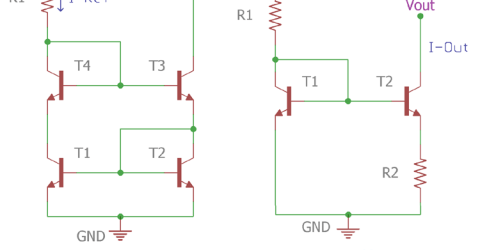
Current Mirror Circuit: Wilson and Widlar Current Mirroring Techniques In the previous article, we discussed about Current Mirror Circuit and how it can be built using a Transistor and a MOSFET. Even though a basic current mirror circuit can be constructed using two simple active components, BJTs and MOSFETs or using an amplifier circuit, the output is not perfect, as well as it has certain limitations and dependencies on the external factors.… |
|
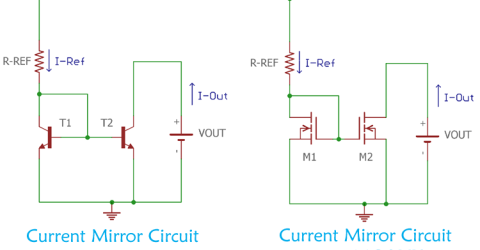
Current Mirror Circuit (Part 1): Introduction, Characteristics and Construction The Current Mirror is a widely popular technique for monolithic IC design. In this technique, the circuit is designed in such a way that it copies the current through one active device to another active device with current control feature. In this, the current is flowing through one device can be copied into another device but in inverting form. If the current of the first… |

|
Current Sensing Techniques using Different Current Sensors Current is a very critical factor in Electronics or Electrical Engineering. In electronics, current can have a bandwidth from few nano-amperes to hundreds of amperes. This range can be much wider in Electrical domain typically to several thousand amperes, especially in Power Grids. There are different methods to sense and measure current inside a circuit or a conductor. In… |
