
Circuit Design

|
How to build a Wearable Air Quality Monitor Pendant using STM32 & SGP40 Sensor Indoor and outdoor air pollution significantly impacts human health, causing respiratory issues and reducing life expectancy. Personal air quality monitoring has become essential for protecting ourselves from harmful airborne contaminants like volatile organic compounds (VOCs), particulate matter, and toxic gases. This DIY wearable air quality monitor pendant… |

|
Flip-Flop in Digital Electronics: Types, Truth Table, Logic Circuit and Practical Demonstration A flip-flop in digital electronics is formally defined as "A bistable device with synchronous inputs that changes state only at specified transitions of a clock signal" (IEEE Standard 91/1984) In general, flip-flops are fundamental components in digital electronics, capable of functioning as 1-bit memory storage devices. Unlike… |

|
How to Build a Desktop Weather Station Using ESP32 and E-ink Display In today’s fast-paced world, many of us spend long hours indoors—whether working from home, studying, or just managing our daily routines. Natural cues like changing skies, outdoor temperatures, or the feel of humidity are often lost behind four walls and closed windows. This can make it difficult to stay aware of what’s happening outside, especially when our focus… |

|
Meet the New Arduino UNO R4 Faster, More Powerful, and More Versatile than Ever Before Arduino has announced two new boards to the Arduino family UNO R4 Minima and UNO R4 WIFI. The board maintains the same form factor and shield compatibility as its predecessor but offers a significant increase in performance thanks to its Arm Cortex-M4 core based, RA4M1 32-bit microcontroller from Renesas. Compared to the UNO R3, the UNO R4… |

|
Comparison Between the Popular Electronics Simulation and EDA Software – Which one should you choose? Electronic Design Automation software or EDA software are tools used for designing circuits such as Integrated Circuits and PCBs. But before even designing the PCBs, engineers utilize software to check whether their electronics designs will perform as expected or not, and to do so they utilize the electronics circuit simulation software. Circuit simulation software… |

|
How to Replace a Comparator IC using Op-Amp? Parameters to be Considered for an Efficient Design In practical electronic circuits, signal processing is an important constraint and different types of methodologies are required to satisfy the customer demand of various design requirements. For any of the signal conditioning requirements, the Op-Amp is the first choice for any designer to comply with the design requirements and in most cases, the Operation amplifiers will… |

|
Long Range Arduino Based Walkie Talkie using nRF24L01 We are living in the era of 5G and 5G-enabled devices; however, old technologies like the walkie-talkie system and RF communication system are still paramount in scenarios where a remote, short-distance, cheap, and low-cost communication is required. For example, if you have a building or heavy-weight bearing construction company, then your workers need to communicate with… |

|
Importance of Virtual Ground and Virtual Short in Op-Amp Circuit Designs Operational Amplifiers are the workhorse of analog electronic designs. These humble devices are used from simple voltage followers to complicated inverter designs since the time immemorial. Here at CircuitDigest, we have already discussed a wide range of op-amp circuits and its applications. Today, we will be looking into another interesting concept associated with Op-Amps,… |
|
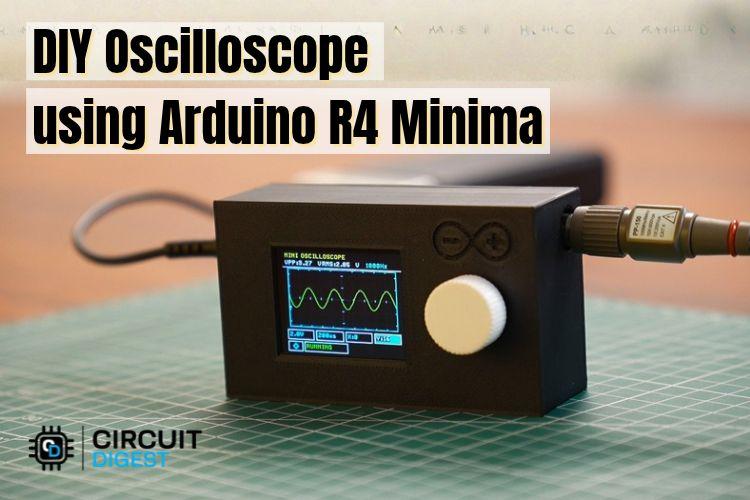
How to Build a DIY Oscilloscope using Arduino UNO Minima? When working with electronics, a multimeter can tell you the voltage at a particular moment, but it cannot show you how that voltage changes over time. To observe these changes and understand what's happening inside a circuit, we need an oscilloscope. But instead of investing in a dedicated instrument, what if we could build a simple one ourselves using a… |

|
PCB Layout Design Guidelines for Switch Mode Power Supply Circuits Switching power supply is a widely used power supply topology in power electronics. Whether it can be a complicated CNC Machine or a compact electronic device, as long as the device is connected to some sort of power supply an SMPS circuit is always mandatory. Improper or faulty Power supply unit could lead to a big failure of the product irrespective of how well-designed… |

|
High Power High Efficiency Buck Converter Circuit using TL494 A buck converter circuit (step-down converter) is a DC-to-DC switching converter that steps down voltage while maintaining a constant power balance. The main feature of a buck converter is efficiency, which means that with a buck converter on board, we can expect extended battery life, reduced heat, smaller size, and improved efficiency. We previously made a few simple Buck… |
|
Design Techniques for Reducing EMI in SMPS Circuits In my previous article on EMI, we examined how the intentional/unintentional nature of EMI sources and how they affect the performance of other Electrical/Electronic devices (victims) around them. The article was followed by another one on Electro Magnetic Compatibility (EMC) which provided insights into the dangers of EMI and offered some context to how poor EMI… |
