
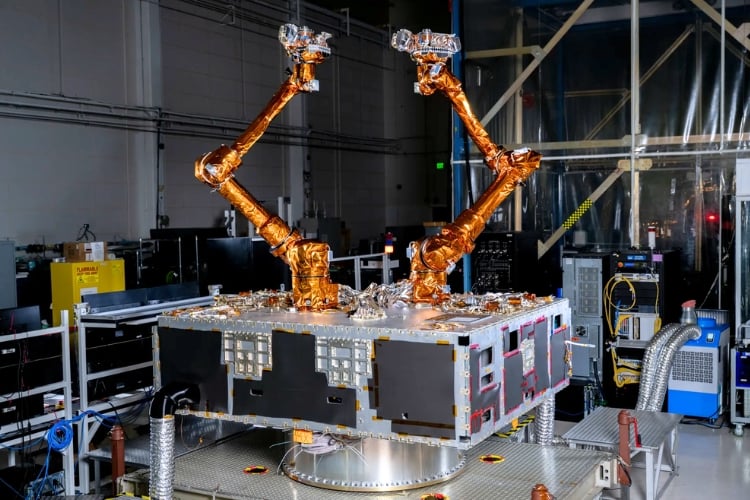
SpaceX launched Northrop Grumman's Mission Robotic Vehicle (MRV) and three Mission Extension Pods (MEPs) aboard a Falcon 9 rocket from Cape Canaveral Space Force Station on July 21. The spacecraft is now making its way to geostationary orbit, where the servicing campaign will begin in the coming weeks. The MRV is equipped with two 10-foot robotic arms built under the Robotic Servicing of Geosynchronous Satellites (RSGS) program.
The RSGS payload was developed at the U.S. Naval Research Laboratory with funding from DARPA. MRV will retrieve each pod in turn, approach a customer satellite, and use its two robotic arms to install the pod on the spacecraft before backing away and repeating the process for the other two customers. The pods do not transfer fuel into a satellite; instead, they attach to the structural ring at the rear of the spacecraft and rely on their own electric propulsion systems for station-keeping.
Because the mission required the Falcon 9 booster's full performance to reach geostationary transfer orbit, SpaceX did not attempt to recover the first stage, ending its service after a record 32 flights. MRV is designed to service multiple satellites over an expected operating life of about 15 years, unlike Northrop's earlier Mission Extension Vehicles, which remained attached to a single satellite for years. NASA is providing supporting expertise to the RSGS program, including simulation and analysis tools and a team of flight robot operators.

Add a comment
No account needed. Your comment appears once a moderator has reviewed it.