
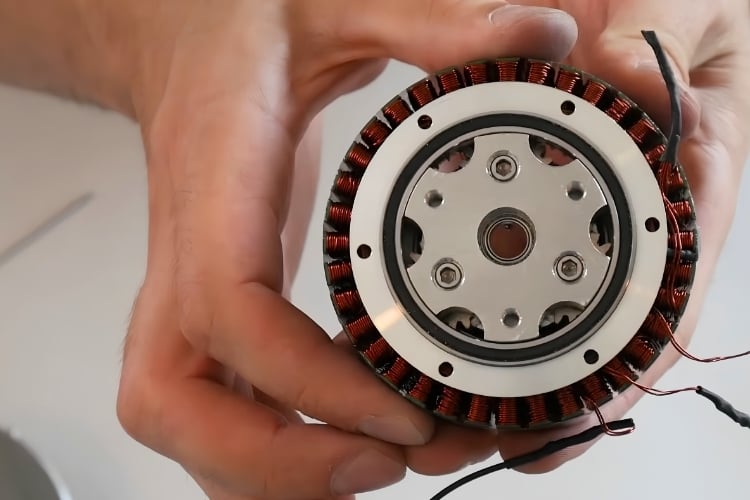
A Sweden-based creator who posts under the name Food For Robots has hand-wound and machined a custom electric actuator from scratch for a bipedal walking robot project, and in the process documented a counterintuitive result about motor design: adding more turns of copper wire to a motor's stator does not increase torque output for a given amount of electrical power.
The creator's first actuator, a 3D-printed design using a rope-based drivetrain, snapped under load and topped out at 10 newton meters of torque, well short of what the robot required. The rebuild moved to CNC-machined aluminum and a planetary gearbox packed into the hollow center of a custom-wound stator, a common technique in compact robotic actuators.
During testing, the actuator failed to deliver the expected performance gains despite a redesigned motor. Investigating the shortfall led to the discovery that, for a fixed motor size and fixed amount of copper, adding more winding turns increases coil resistance in roughly the same proportion that it increases torque per unit of current. Measured resistance quadrupled when turns were doubled from 18 to 36, while the wire's cross-sectional area was halved to fit the same slot. The two effects offset one another, meaning torque per watt at stall stays effectively constant regardless of turns count for a given stator.
The finding also clarified why torque scaled with the square root of input power rather than linearly with it, a relationship traced to the fixed relationship between phase voltage and current in the copper windings under stall conditions. After adjusting supply voltage and current limits based on the corrected model, the rebuilt actuator produced close to double the torque of the original 3D-printed version, weighing 900 grams and measuring 102mm in diameter. The creator has not disclosed a timeline for integrating the actuator into a functioning walking robot.

Add a comment
No account needed. Your comment appears once a moderator has reviewed it.