

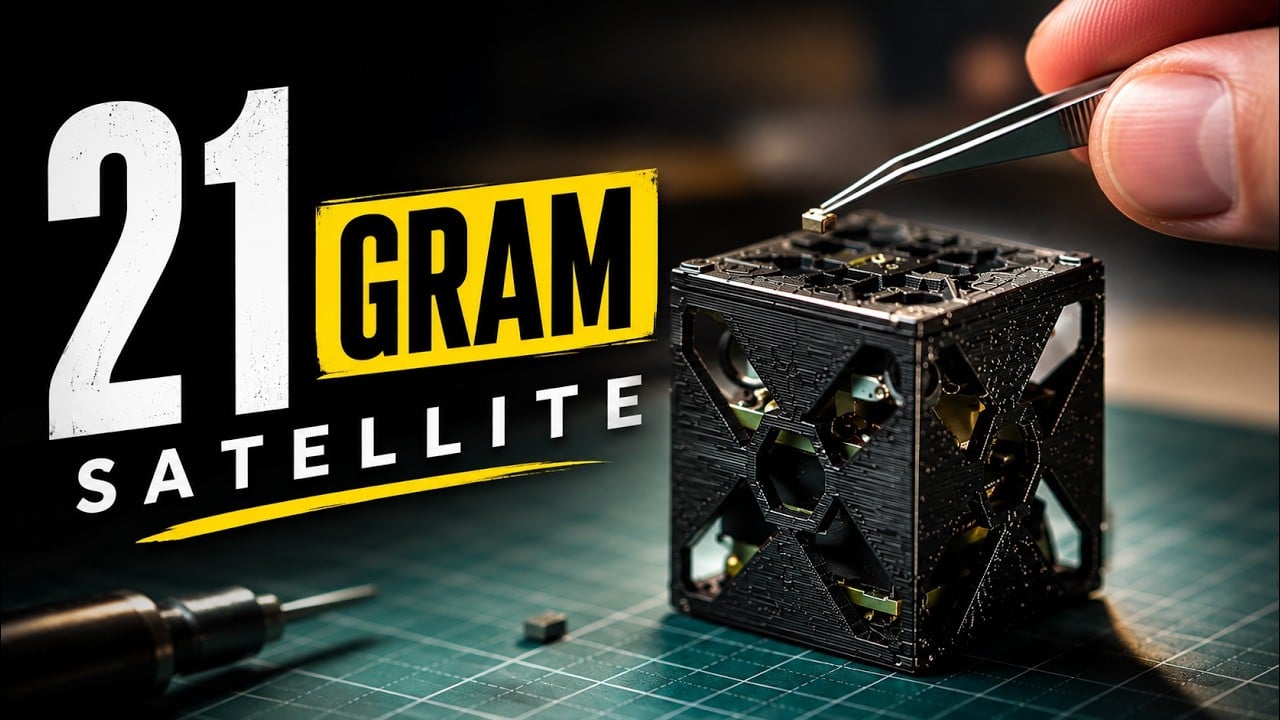
A tiny satellite prototype weighing just 21 grams is showing how far small-scale electronics can be pushed when size and weight become the main design targets. The compact device, developed as a suborbital satellite prototype, measures only 28 × 28 × 33 mm and packs an ESP32-C3 Mini microcontroller, environmental sensors, an inertial measurement unit (IMU), onboard data storage and a battery connection into a remarkably small package. The project was inspired by the idea of ultra-light satellites such as KalamSat, but it is important to note that this particular 21-gram device has not been launched into orbit. Instead, it is a ground-built prototype designed to demonstrate how a very small spacecraft-like system could collect and record useful data during future flight experiments.
The electronics were first tested using a breadboard before being redesigned around a much smaller zero PCB. An ESP32-C3 Mini acts as the main controller, while a BME680 measures temperature, humidity, atmospheric pressure and gas resistance. A second sensor, the BMI323, adds a 3-axis accelerometer and gyroscope, allowing the system to track acceleration and rotational movement. To reduce size and weight, the developer removed unnecessary connectors and PCB sections and soldered the components directly onto the boards. The sensor boards were connected to the ESP32 using the I²C communication interface, reducing the number of wires needed inside the tiny assembly. A custom 3D-printed enclosure was then designed to hold the electronics. The final result weighs only 21 grams well below the original 30-gram target while still providing environmental and motion sensing capabilities.
The prototype also includes a software dashboard for monitoring and storing the collected measurements. During testing, the accelerometer and gyroscope responded to movement and rotation in real time, while the environmental sensors continuously updated temperature, humidity, pressure and gas-resistance readings. For a more demanding temperature test, the entire prototype was placed inside a freezer, where the dashboard showed the temperature falling as the device cooled. The system can also organize recorded flight data into files that can later be viewed, downloaded or deleted. Because this is currently a suborbital satellite prototype, it does not use a dedicated telemetry system; instead, the collected data is intended to be recovered after a mission. The project highlights an important direction in modern space technology: shrinking satellite electronics does not simply mean making a smaller box; it requires reducing connectors, PCB material, wiring and mechanical structure while keeping the sensing and computing functions intact. At 21 grams, this prototype demonstrates just how compact a spacecraft-inspired electronics platform can become, while leaving the much harder challenge of actually sending it into space for a future mission.

Add a comment
No account needed. Your comment appears once a moderator has reviewed it.