
power electronics

|
RF Energy Harvesting - Converting Radio Frequency into Electrical Energy There are many wireless devices working across the world which makes the people’s life easy and comfortable in many ways, but all these wireless devices are needed to be charged again and again to use them. But what if, we can use the same radio frequency that transfers data, to charge the devices. This technology would reduce or omit the use of batteries for powering the… |

|
12V 1A SMPS Power Supply Circuit Design on PCB Every Electronic device or product requires a reliable power supply unit (PSU) to operate it. Almost all devices in our home, like TV, Printer, Music Player etc. consists of a power supply unit built into it which converts the AC mains voltage to a suitable level of DC voltage for them to operate. The most commonly used of type of power supply circuit is the SMPS (Switching… |

|
XP Power introduces wide-range input power modules for industrial and ITE applications XP Power has introduced two new series of wide input range chassis and DIN rail mount DC-DC converters, which can be installed into a wide variety of industrial and ITE applications.
The DTE06 and DTE10 DC-DC converters provide 6W and 10W of power output. Further offering an input range 4:1 and allowing a wide… |

|
Diode Clamper Circuits Previously we learned about Clipper Circuits, which are used to clip off the positive or negative part of the Alternating waveform. Today we will learn about Clamper circuits which are used to clamp the DC level of the output signal without distorting the waveform i.e. they are Level Shifter circuits. It can be designed using capacitor, diode and resistor. The… |
|
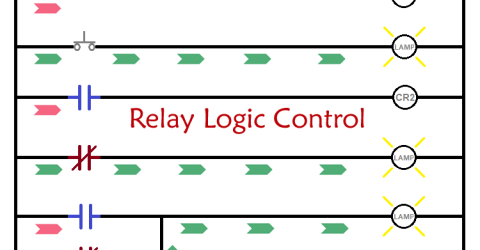
Introduction to Relay Logic Control - Symbols, Working and Examples Relay logic control systems are truly a foundation of industrial automation, and electromagnetic relays are necessary to perform switching actions in these conversion systems. The relay logic circuits also utilise relays along with switches, motors, timers, actuators, and contactors to form ON/OFF control systems effectively. Though relay logic control proves to be effective… |

|
Schottky Diode – Characteristics, Parameters and Applications A diode is one of the basic components that are commonly used in electronic circuit designs; it can be commonly found in rectifiers, clippers, clampers and many other commonly used circuits. It is a two-terminal semiconductor device that allows the current flow in only one direction, that is, from Anode to Cathode (+ to -) and blocks the current flow in the reverse direction… |

|
Transformerless LED Driver Circuit for Reliable Low Cost LED Bulb Designs LED bulbs are said to be 80% more efficient than other conventional lighting options like fluorescent and incandescent bulbs. The fast adaption of LED bulbs is already noticeable around us and the global LED bulb market value has reached to around $5.4 Billion in 2018. A challenge, in designing these LED bulbs is that LED light, as we know works on DC voltage and the mains… |

|
Mechanically powered Emergency Flashlight Flashlight or Torch is very useful in emergency situations like power failure. These flashlights are battery-operated, and we have to charge regularly in particular intervals. But what if you don’t have electricity and your flashlight is dead? In that situation, Mechanical chargeable Flashlights is very good option, which can be charge by rotating the lever attached to it.… |

|
What is Bleeder Resistor and where it is used? Bleeder resistors are standard high value resistors which are used to discharge the capacitor in filter circuit. The discharging of the capacitors is really important because even if the power supply is OFF, a charged capacitor can give a shock to anybody. So it is really essential to add a bleeder resistor to avoid any mishaps. It also have other applications but the main… |

|
Diode Clipper Circuits: Design & Demonstration As the name suggests, Clipper circuit is used to “clip” a portion of input signal without distorting the remaining part of the waveform. It is a wave shaping circuit. This can be very useful in the circuits where the input signal attains a higher value of voltage than the expected one. These circuits can be implemented in various ways according to the configuration or… |

|
How to Measure Current with an Oscilloscope Measuring current is a simple task – all you need to do is hook up a multimeter to the circuit you want to measure and the meter gives you a clean value to use. Sometimes you can’t really ‘open up’ the circuit to put a multimeter in series with what you want to measure. This is solved quite simply too – you just need to measure the voltage across a known resistance in the… |

|
Galvanic Isolation – Signal Isolation and Power Isolation An average household microwave oven operating at 110/220V AC can produce upto 2800V inside it, which is dangerously lethal. Besides that it also has a lower level AC voltage around 3.5V to light up the filament and a regulated DC voltage like 5V/3.3V for the digital electronics part like the display or timers to operate. Have you ever wondered… |
