

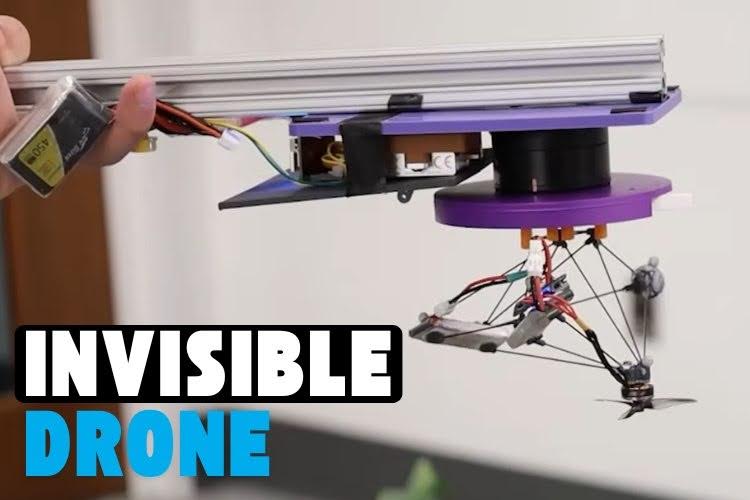
Northwestern University engineers have unveiled Phantom Twist, a groundbreaking low-visibility UAV that exploits human visual perception to hide in plain sight. The drone spins its entire body at up to 25 rotations per second using a single motor and counter-rotating propeller system. Unlike traditional quadcopters with stationary bodies, Phantom Twist has no fixed parts during flight, creating extreme motion blur through persistence of vision. The human eye integrates visual signals over roughly 100 milliseconds, so the rapid rotation turns the drone into a faint, semi-transparent haze that blends with the background. Researchers employed advanced computational design, testing over 20,000 configurations with AI optimization algorithms. Components including the motor, propeller, circuit board, batteries, counterweights, and 0.8mm carbon fiber rods were strategically placed to minimize visual overlap from multiple angles, evaluated using the LPIPS (Learned Perceptual Image Patch Similarity) metric.
The optimized design achieved a remarkable LPIPS score of 0.0104, making it approximately 10 times less visible than a conventional quadcopter. Control is achieved by pulsing motor speed at precise points during each rotation for translation, while the spinning provides passive stability. Currently relying on indoor optical tracking, the team plans outdoor autonomous flight using techniques from prior projects. The Phantom Twist represents a significant advancement in stealth drone technology, shifting focus from traditional camouflage or optical cloaking to motion-based invisibility. As detailed in IEEE Spectrum and the original Northwestern release, this approach could revolutionize applications such as wildlife monitoring, environmental surveys, and infrastructure inspection, where minimizing visual disturbance is critical. Project lead Michael Rubenstein highlighted the potential for mounting a camera on the spinning body to capture 360-degree imagery for onboard navigation.
Future iterations aim to address remaining limitations, including propeller noise and visible support structures, by incorporating more transparent materials and quieter propulsion methods. The research was presented at Robotics: Science and Systems (RSS) 2026 in Sydney, with the full paper titled “Computational Design of a Low-Visibility UAV Using a Human-Aligned Perceptual Metric” available on arXiv.

Add a comment
No account needed. Your comment appears once a moderator has reviewed it.