

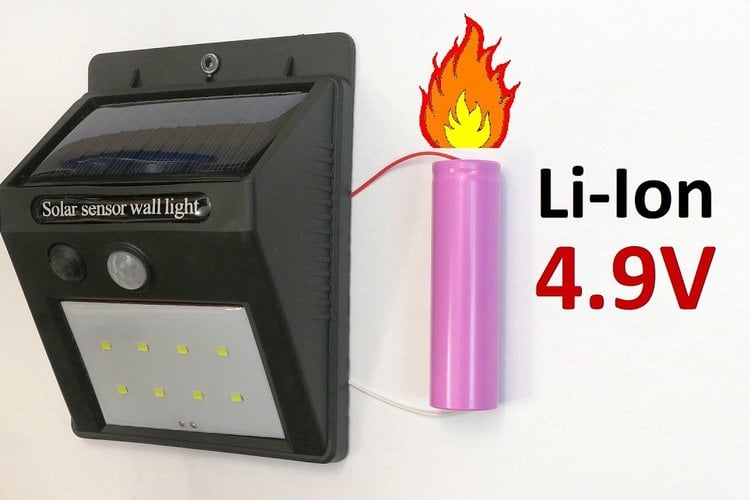
Cheap solar wall lights are on millions of walls, and most people never think about the battery inside. YouTuber DiodeGoneWild opened one that was sold in a Czech supermarket, by a Czech company, with a PIR motion sensor, an "IP44" rating and an 18650 Li-ion cell. What he found inside led him to title the video "LED Solar Sensor Houseburner".
No charger, no protection
The 18650 cell is unprotected, and the circuit has no charge management and no cell protection at all. As Hackaday points out, the best guess is that someone took a circuit designed for a NiMH cell and simply swapped in a Li-ion cell. The 5.5 V-rated solar panel pushes about 6 V at the cell. In an outdoor test, the cell reached 4.8 V before the sun went behind a building. A Li-ion cell should stop charging at about 4.2 V. Above that it degrades fast and, in the worst case, can vent, catch fire or explode. The "IP44" enclosure also has plenty of gaps and holes.
Why NiMH got away with it
A NiMH cell tolerates a small trickle of overcharge by turning the extra energy into heat, which is why the simplest solar lights can charge it straight from the panel through a diode. Li-ion does not forgive that. It needs a charger that limits the voltage, and ideally a protection circuit that cuts off at full charge and at low voltage.
Key details
- Product: outdoor solar wall light with PIR sensor and LEDs, sold in a Czech supermarket
- Battery: one unprotected 18650 Li-ion cell
- Charging: no charge controller; 5.5 V-rated panel charging at about 6 V
- Measured: cell at 4.8 V during an outdoor test (Li-ion full charge is about 4.2 V)
- Enclosure: labelled IP44, with visible gaps
What to do if you have one
If a solar light uses a Li-ion cell, open it and look for a charger IC or a protection board. If there is none, a cheap one-cell charger and protection module, or a small regulator that limits the charge voltage to 4.2 V, makes it much safer. If you design these products, this is a reminder that a battery swap is never just a battery swap: the charging circuit has to change with it.
Image credit: DiodeGoneWild (YouTube), video thumbnail, cropped and resized.
About the author: Aswinth Raj is an electronics engineer and the editor of CircuitDigest, where he has published more than 150 hands-on projects and tutorials across Arduino, PIC, ESP32, Raspberry Pi and EV battery systems. He selects the stories on this page for what engineers and makers can actually learn or build from. Connect on LinkedIn

Add a comment
No account needed. Your comment appears once a moderator has reviewed it.