
 Vedhathiri
Author
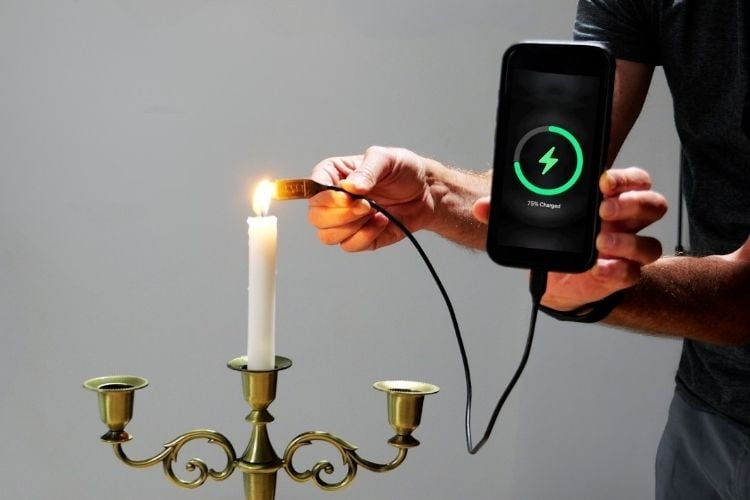
A simple candle flame can be used as a small thermal power source when combined with a thermoelectric generator (TEG), a solid-state device that converts a temperature difference directly into electrical energy. A maker from the YouTube channel The Action Lab recently demonstrated this concept by using a candle to heat one side of a thermoelectric module while continuously circulating water through the opposite side to keep it cool. This created the temperature gradient required for power generation, producing enough electrical output to illuminate multiple LEDs and even charge a smartphone. The technology relies on the Seebeck effect, first identified by physicist Thomas Johann Seebeck in 1821, which causes a voltage to develop across a material when there is a temperature difference between its two sides. Unlike conventional generators that rely on mechanical movement, rotating coils, or magnetic fields to produce electricity, a TEG has no moving parts and directly converts thermal energy into electrical energy through thermoelectric semiconductor materials. This makes thermoelectric generators particularly useful for waste-heat recovery and thermal energy harvesting, where heat from flames, engines, exhaust systems, industrial equipment, and other sources can otherwise be lost to the surrounding environment.
Inside a typical TEG are numerous p-type and n-type semiconductor elements, commonly manufactured using materials such as bismuth telluride, connected electrically in series and thermally in parallel between ceramic plates. When the hot side is exposed to the candle flame, charge carriers in the semiconductor elements gain thermal energy and begin moving from the hotter region toward the colder region. Because the transport of charge carriers differs between the p-type and n-type materials, this movement creates a voltage across the thermoelectric circuit. The generated voltage is related to the temperature difference and the material's Seebeck coefficient, which describes how much voltage a material can generate for a given temperature gradient. However, the module cannot generate useful power simply by making one side hot; the cold side must remain sufficiently cool. If both sides approach the same temperature, the temperature gradient falls and so does the electrical output. In the demonstration, water was pumped through the cold-side heat spreader to continuously remove heat and maintain the temperature difference. The thermoelectric module therefore operates as a thermal-to-electrical converter, with heat flowing from the candle through the hot side, across the semiconductor elements and into the cooling system while a portion of that thermal energy is converted into electrical power.
The electrical output from a TEG is typically low-voltage and depends heavily on the temperature difference, thermoelectric material properties, module resistance and the effectiveness of the cooling system. For practical applications, the raw output may need to pass through power-management electronics, such as a DC-DC boost converter, voltage regulator, battery charger or USB power-management circuit, before it can be used by a modern electronic device. The candle experiment demonstrates the complete concept: chemical energy stored in the wax is released through combustion as heat, the heat creates a temperature gradient across the TEG, the Seebeck effect converts part of that gradient into electrical energy, and the resulting electricity can then be conditioned for LEDs or smartphone charging. The demonstration does not make a candle a high-power energy source, since the available electrical power is limited by the candle's heat output, the achievable hot-to-cold temperature difference and the relatively low efficiency of thermoelectric conversion. Its significance is instead in showing how even a small and continuous heat source can become an electrical source when a stable temperature gradient is maintained. The same technology can be scaled or adapted for waste-heat recovery, industrial thermal systems, remote sensors, exhaust heat harvesting, camping power systems and other applications where conventional electrical power is difficult to access but a persistent temperature difference is available.