
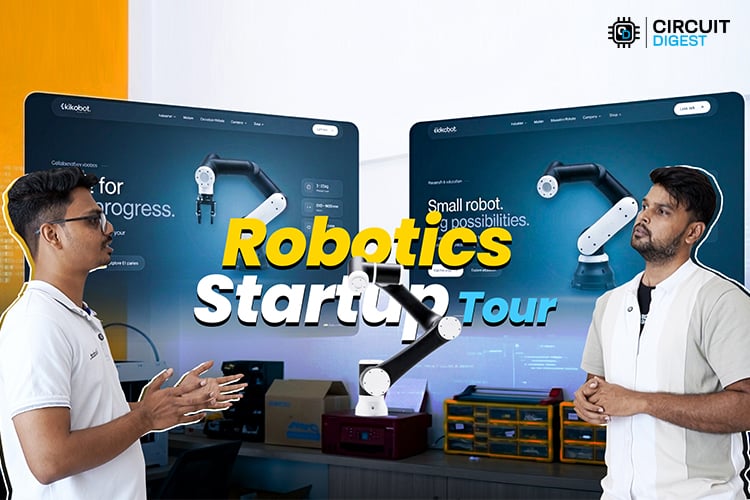
Kikobot Robotics is an early-stage hardware startup in Pune. It began by building robotic arms for education and research and has since moved into industrial-grade arms and its own actuators. Raghvendra says the company builds robot arms for education, research and physical AI, and arms for industrial use cases as well. The lineup includes cobots, delta robots and gantry systems.
An Automation Expo and an Intern From an IIT
Raghvendra says the team began building robotic arms in 2024. He mentions a friend who is a product designer, and says the robot was designed and 3D printed. The first prototype was ready within about two months.
The team then took the small robot to an automation expo, where it was shown in front of big robots with payloads such as 100 kg and 200 kg. Raghvendra says there was no conversion at the expo. A few months later, he says, the first customers came and the team started producing the robots.

He says one intern who was working with the team was from one IIT and recommended the robot for a project they were trying to do. He also says his first sale was to one of the IITs.
The work began as a college project. Raghvendra showed it to an investor, who asked why he didn’t build the robots at scale or sell them to education and industry. He says that is how the college project became a product.
Robot Arms for Classrooms and Factories
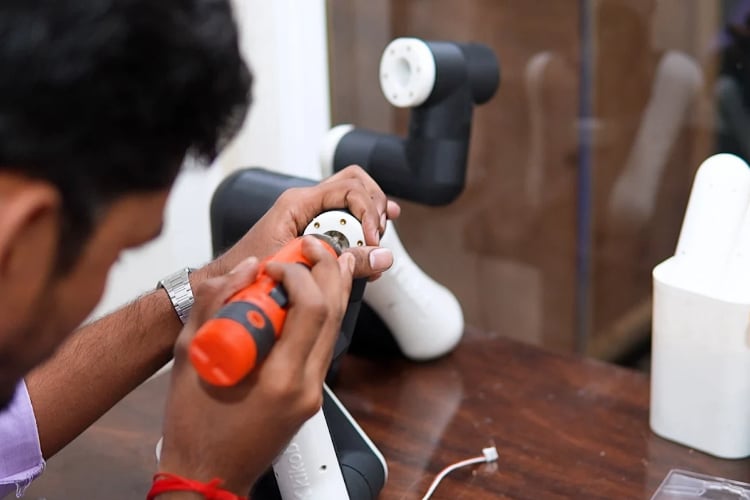
The C1 is the smaller arm. The C2 is a six-axis cobot for desktop-grade applications, with higher reach and payload than the C1. Raghvendra says it can be used for teleoperation in physical AI, training data sets, and teaching students ROS, Python and some machine learning vision. Asked what actuators the robots come with, he says serial bus servo motors are used and are convenient for students.
The industrial arm shown is a six-axis robot with a 3 kg payload and a reach of up to 600 mm. Raghvendra says each axis moves at around 180 degrees per second, and that there is an actuator in each joint. He lists pick and place, dispensing, welding, material handling and machine tending as applications, and says end effectors can be mounted on the arm.
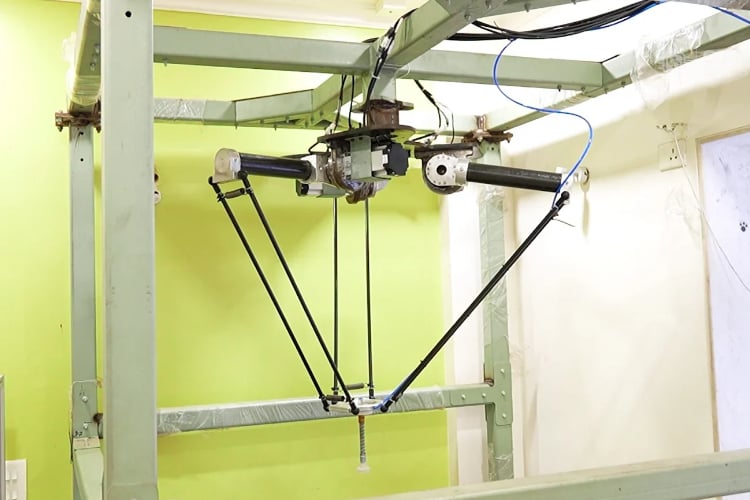
The delta robot shown is a bigger variant built for fast pick and place, such as sorting, segregation and packaging on a conveyor. He gives the example of putting pouches into boxes. He says these robots are mainly used in FMCG and pharma industries and that this one runs at about 120 cycles per minute.
Asked what makes Kikobot different, he says many arms on the market are from China, Europe and, he thinks, the US, and that it is difficult for students because of limited information about them. That is why he started with a small desktop-grade cobot, which leaves many options open for students to integrate their own things, including ROS. He says that compared with Chinese and Indian costs, Kikobot’s cost is lower than its competitors’ right now.
On how the price is lower, he says making a robot cheaper means controlling the manufacturing, the outer, the actuators and the controller. Kikobot designs the robots and has them manufactured by its partners, which he says is how it gets a lower price point.
Why Kikobot Decided to Build Actuators
Raghvendra says the heart of industrial robots is the actuator. He researched how actuators work and how they are made, and found that Chinese companies sell actuators to India and that their robots are far cheaper than their actuators. The team then decided to make its own, to reduce dependency on Chinese parts. He says the research and iteration took a good amount of time.
He describes an actuator as the complete set of gearbox, motor, encoder, FOC driver and brakes, plus the mechanical assembly around them, with about six actuators in one robot. The unit shown breaks down as a harmonic gearbox, a BLDC motor, brakes, an encoder and an FOC driver board. He says the harmonic gearbox suits very high-precision tasks where precision in micrometers is needed, and that a planetary gearbox can be attached depending on the use case.
At this scale, he says, Kikobot is not building its own harmonic drives and BLDC motors, calling that a very capital intensive job for small startups. The company designs its own encoders and FOC boards, along with the algorithm and firmware behind them, and builds the brakes. These are assembled together to make an actuator.
He says the actuators were previously made for Kikobot’s own cobots. The company now sells them to customers because many robotics companies want indigenous actuators. He says they can be used in cobots, quadrupeds, humanoids and exoskeletons.
His view is that when you have a perfect actuator for your use case, it is easier to build a robot from it. Getting it right meant working on torque ratios, speed ratios and thermals, and he says it took quite a good amount of time.
Ten, Fifteen or Twenty Versions
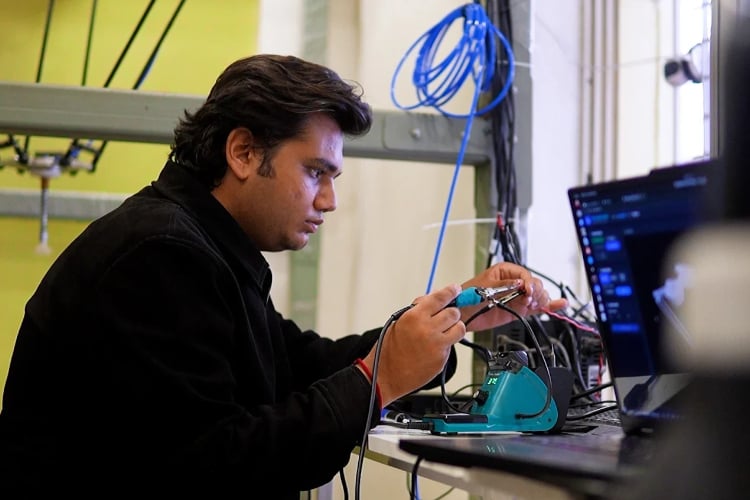
On hardware R&D, Raghvendra says the move from a first version to a sales-ready one can take ten, fifteen or twenty versions. Customer feedback adds another two or three iterations. He says part of the difficulty is waiting on PCB manufacturers, followed by design, testing and iteration.
Electronics assembly, PCB assembly and board R&D are done in one room of the workspace, covering the electronics behind the actuators and the small robots. He says getting a good-quality PCB manufacturer in India is difficult, naming six-layer and eight-layer boards. Early on, boards were manufactured in China, and the company is now thinking of sourcing from Indian vendors. He says the engineers got their first PCB, a six-layer board, within about one and a half to two months. It worked on the first attempt and has not been changed since, and the team is still testing it.
The workspace also has a few workstations used for mechanical design and for training physical AI models.
Up to 50 Robots Sold Last Year
Raghvendra says Kikobot sold up to about 50 robots last year across education and industry, with the majority being the C1 and C2 desktop robots for STEM education. He says he thinks sales will increase by about 60 to 70 percent this year, and that the team is already trying to reach its target within six months.
He cites a report saying India has only about seven robots per 10,000 people, which he describes as a huge gap with a lot of demand. He says demand is rapidly increasing among Indian students for desktop-grade robots and among Indian manufacturers for industrial-grade ones, and he expects the number of deployments to be a lot higher in the next two to three years.

Add a comment
No account needed. Your comment appears once a moderator has reviewed it.