
Analog Electronics deals with electronic systems that has a continuous variable signal. In this section we will discuss about various analog electronic projects that can be used to design your own amplifiers, oscillators, filters, analog converters, waveform generators and other analog circuits as required by your application.

TI's new operational amplifier and comparators reduce overall system footprint in IoT, personal electronics, and industrial applications
Texas Instruments introduced the industry’s smallest op-amp and low power comparators at 0.64 mm2. Manufactured in compact X2SON package, the TLV9061 op-amp and TLV7011 family of…

As established in the first part of AC Circuit Theory, when a magnet rotates around a coil or a coil rotates around a magnetic field, an Alternating current or voltage is generated. The rotation of either the magnet or the coil which leads to the periodic alternation in direction and magnitude of the Voltage (or current) leads to the generation of some sort of…

Previously we have built simple Square Wave Generator circuit, today in this tutorial, we are going to show you how to generate Sine wave using few basic components like transistor, resistor and capacitor. Sine wave is most commonly known as waveform for Alternating Current. In this circuit we will also build that alternating waveform, we can adjust the frequency or reduce…

An electrical circuit is a complete conductive path through which electrons flow from the source to the load and back to the source. The direction and magnitude of the electrons flow however depend on the kind of source. In Electrical Engineering, there are basically two types of voltage or current (Electrical Energy) source which defines the kind of circuit…

Frequency Dividers are the circuits which divide the input frequency by n (any integer number), means if we provide some signal of frequency ‘f’ then the output will be the divided frequency ‘f/n’. Frequency dividers are very useful in analog as well as digital applications. Here we are building the circuit to divide the frequency by 2 or 4.
In this…

Electronics has always been fun to play with, once we learn the very basics of how each component works and how to use them in our circuit it’s fairly easy to design, simulate and fabricate our ideas into a PCB. In this project let’s build a simple fun circuit, analyse it and then fabricate a PCB to improve our learning curve. The concept behind this Lie Detector Circuit is…

Have you ever feel a shock by touching the switch? It does not generally happen but sometimes physical contact with switches may be dangerous. But what if the switch gets wireless and you don’t have to press any button at all for switching on or off your home appliances. So today we are building a Simple Wireless Switch Circuit in which there is no need of physical contact…
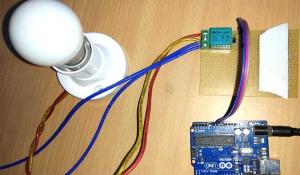
LED Blinking is a very common and almost first program for every embedded learner or beginner. In which we blink an LED with some delay. So today we are here with the same project, but here we will use an AC bulb instead of a normal LED and will blink an AC bulb. You can also drive into this project of Relay Interfacing with PIC Microcontroller.
…

As our brain is made up of 100 billion of cells termed Neurons which are used to think and memorize things. Like as computer also have billions of tiny brain cells named Transistors. It is composed of chemical element extract from sand called Silicon. Transistors change the theory of electronics radically since it has been designed over half a century before by John Bardeen…

Door alarm is a very common and useful device for security purpose. They are used to detect whether the Door is open or closed. Often we have seen some door alarm in the refrigerator that produced a different sound when they activate. Door Alarm Projects are very popular among the Electronics students and hobbyists. We have also built many alarms based on various…

“Automation is good, so long as you know exactly where to put the machine’’, In this tutorial we are making a Temperature controlled DC fan using Thermistor, as it starts above the preset level of temperature and stops when the temperature return to normal condition. This whole process is done automatically. We have previously made the Temperature controlled Fan using…

Here, we are going to show you how to make an LED Roulette Circuit using 555 timer IC, before starting the tutorial let you know about what the roulette is, it’s a casino game named after the French word which means little wheel. As same, here we are making a wheel (or circle) shaped led blinker, using 555 timer IC placed in Astable mode, and IC 4017 which is decade counter…