
Frequency Counter

|
World's First Approved Automated Frequency Coordination System Administrator for Superior Wi-Fi Experiences Qualcomm Technologies, Inc. achieved a significant milestone by being designated as the inaugural Automated Frequency Coordination System Administrator (AFCSA) for commercial operations in Canada, a global first in this realm. This recognition, bestowed by Innovation, Science and Economic Development Canada (ISED), endows Qualcomm… |

|
A Basic Introduction to Grid Dip Meter The Grid Dip Meter (GDM) or the Grid Dip Oscillator (GDO) is an electronic instrument used in measurement and testing of radio frequency circuits. It is basically an oscillator with an exposed coil and oscillation amplitude readout. It has three main functions: Measuring the resonant frequency of an LC resonant circuit, a Crystal/Ceramic resonator, or an Antenna,… |
|
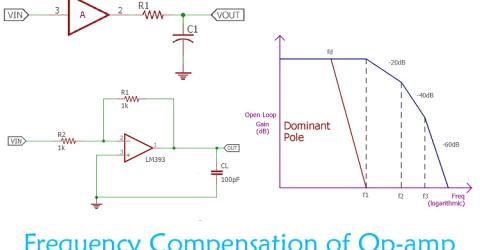
Frequency Compensation of Op-amp and why it is important in your Op-Amp Circuits Operational Amplifiers or Op-Amps are considered the workhorse of Analog Electronic Designs. Back from the Analog computers era, Op-Amps have been used for mathematical operations with analog voltages, hence the name operational amplifier. To date, Op-Amps are extensively used for voltage comparison, differentiation, integration, summation and many other things. Needless to… |

|
Quartz Crystal Oscillator In our previous RC Phase Shift Oscillator and Wein Bridge Oscillator tutorials, we get fair idea about what is an Oscillator. An oscillator is a mechanical or electronic construction which produces oscillation depending on few variables. A proper good oscillator produces stable frequency. In case of RC (Resistor-Capacitor) or RLC (Resistor-Inductor-… |

|
8051 Microcontroller based Frequency Counter Frequency is defined as number of cycles per second. It can also be defined as reciprocal of total time ‘T’. In this project we are going to count the number of pulses entering into Port 3.5 of 8051 microcontroller and display it on 16*2 LCD display. So basically we have measuring the frequency of signal at Port 3.5 of 8051. Here we have used AT89S52 8051 chip, and a… |

|
Frequency Counter using Arduino Almost every electronic hobbyist must have faced a scenario where he or she must measure the frequency of a signal generated by a clock or a counter, or a timer. We can use an oscilloscope to do the job, but not all of us can afford an oscilloscope. We can buy equipment for measuring the frequency, but all these devices are costly and are not for everyone. With that in… |