
Digital Electronics

|
Missing Pulse Detector Circuit When a signal goes through a sudden change from base value to higher value and again comes to base value from higher value after some time. It is called a Pulse signal. In above image, the first waveform shows a single pulse where the signal is changing from 0 to 5v (low to high) and 5v to 0 (high to low) within a short… |
|
Synchronous CounterWhat is a Counter?
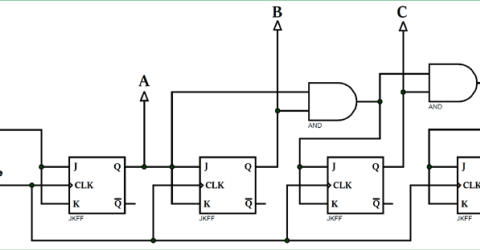
A counter is a device which can count any particular event on the basis of how many times the particular event(s) is occurred. In a digital logic system or computers, this counter can count and store the number of time any particular event or process have occurred, depending on a clock signal. Most common type of counter is sequential digital logic circuit… |
|
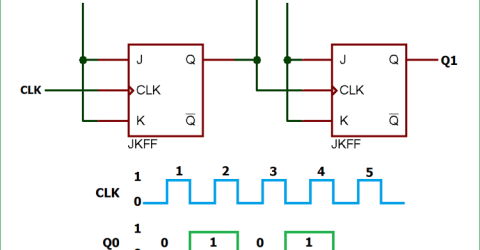
Asynchronous Counter An asynchronous counter (or ripple counter) is a sequential digital circuit in which the outputs of flip-flops are connected in series, so that the output of one flip-flop serves as the clock input to the next stage. Not all flip-flops may change state at the same time as synchronous counters, so asynchronous counters are easier to design but may experience propagation delays. Table of… |
|
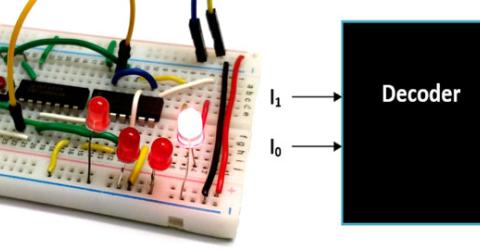
Binary Decoders Decoder is type of combinational Circuit which decodes a small bit value into large bit value. It is normally used in combination with encoders which does exactly the opposite of what a decoder does, so read about Encoders here before you proceed with Decoders. Again just like Encoders there are many types of Decoders as well but the number of output lines in a decoder will… |
|
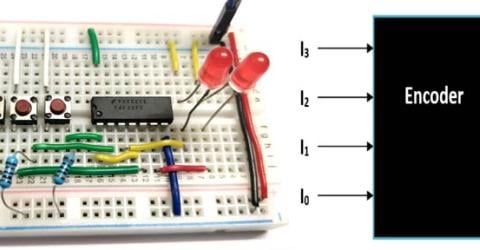
Binary Encoders Encoders, as the name suggest, encodes a larger bit of information into a smaller bit value. There are many types of encoders based on the number of inputs and outputs and based on how it operates. But every Encoder has one underlying rule, the number of output lines on an Encoder will always be less than number of input lines. We will learn more about encoders, what is… |
|
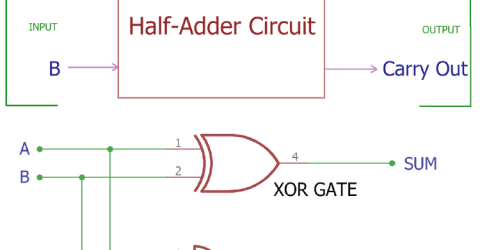
Half Adder Circuit Diagram and its Construction Computers use binary numbers 0 and 1. An adder circuit uses these binary numbers and calculates the addition. A binary adder circuit can be made using XOR and AND gates. The summation output provides two elements: the first one is the SUM, and the second one is the Carry Out. When we use the arithmetic summation process in our base 10 mathematics,… |

|
Different Types of Shift Registers and its Applications with Examples What is Shift Register:
Shift Registers are sequential logic circuits, capable of storage and transfer of data. They are made up of Flip Flops which are connected in such a way that the output of one flip flop could serve as the input of the other flip-flop, depending on the type of shift registers being created. … |
|
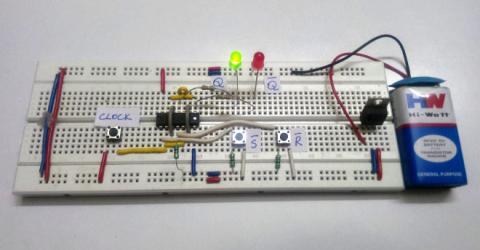
SR Flip-Flop with NAND Gates: Circuit, Truth Table and Working The SR flip flop using NAND gate truth table is a basic sequential logic circuit that holds one bit of digital information. This extensive guide goes over the general SR flip flop circuit diagram with explanation, a discussion of the truth table, and its implementation using IC SN74HC00N. If you want to become proficient in digital electronics and sequential circuit design, it's important to… |

|
Digital Thermometer using Arduino and LM35 Temperature Sensor Thermometers are useful apparatus that have been used for a long time for temperature measurement. In this project, we have made an Arduino based digital thermometer to display the current ambient temperature on a 16x2 LCD unit in real time. It can be deployed in houses, offices, industries, etc., to measure the temperature. We can divide this Arduino… |
