

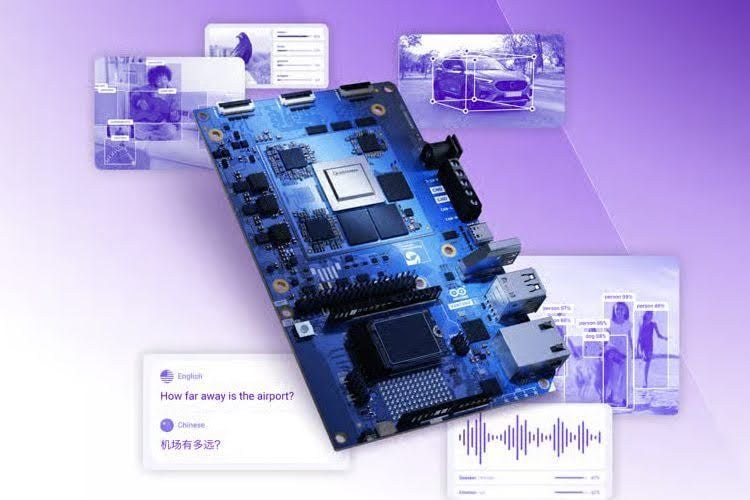
In a major step toward bringing artificial intelligence directly into physical devices, Arduino has unveiled the VENTUNO Q, a new high-performance single-board computer powered by processors from Qualcomm’s Dragonwing IQ8 series. Announced ahead of Embedded World in Germany, the platform is designed to democratize edge AI, robotics, and intelligent automation for developers, educators, and researchers. The name “Ventuno” meaning 21 in Italian, celebrates Arduino’s upcoming 21st anniversary while symbolizing a new generation of intelligent hardware platforms focused on bringing powerful AI capabilities directly to the edge.
Technically, the VENTUNO Q introduces a “dual-brain” architecture that combines high-performance AI computing with precise real-time control. Its main processor, based on Qualcomm’s Dragonwing IQ8 platform, delivers up to 40 TOPS of AI processing power, enabling advanced workloads such as computer vision, speech recognition, and generative AI directly on the device. Alongside this AI engine, a dedicated STM32H5 microcontroller manages time-critical tasks like motor control and robotics movement. The board includes 16GB RAM and expandable 64GB storage, along with modern connectivity features such as Wi-Fi 6, Bluetooth 5.3, 2.5Gb Ethernet, and multi-camera support, allowing developers to build sophisticated AI systems that run locally without relying heavily on cloud infrastructure.
The platform runs Linux distributions such as Ubuntu or Debian for high-level AI workloads, while the microcontroller operates within the Arduino real-time environment using Zephyr OS, ensuring deterministic control for robotics and industrial systems. It also supports modern development frameworks like ROS 2, enabling advanced robotics workflows and AI experimentation. With this architecture, developers can build intelligent machines that perceive, decide, and act autonomously on a single board from offline AI voice assistants and smart kiosks to automated inspection systems and advanced robotics prototypes. By merging its open-source ecosystem with Qualcomm’s edge-AI hardware, Arduino aims to make sophisticated AI development more accessible to millions of developers worldwide.

Add a comment
No account needed. Your comment appears once a moderator has reviewed it.