
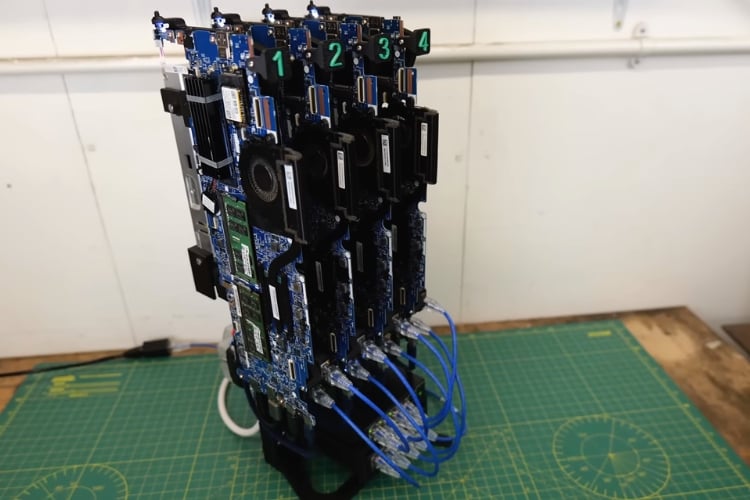
Maker Joe C-J has repurposed four discarded Lenovo ThinkPad L380 laptops into a working, self-hosted AI computing cluster, capable of running large language models entirely offline. Each of the four motherboards was stripped from its laptop chassis and mounted into a custom 3D-printed frame, designed in Fusion and reprinted to accommodate a fourth node after an earlier three-node version of the project. Every board retains an 8th-generation Intel i5 processor, 32GB of DDR4 RAM, an NVMe SSD, and a dedicated 2.5GbE network adapter. Combined, the four nodes pool together 128GB of RAM and four CPUs.
Power is distributed through a 24V fused buzzbar, with individual 5A fuses protecting each motherboard, 3A fuses for the network switches, and a 15A fuse on the main incoming feed, a deliberate improvement over an earlier, less protected wiring setup. Two separate 2.5GbE switches handle networking, one for general internet access and one dedicated solely to communication between the four nodes. On the software side, the builder used an AI coding assistant to help configure Ubuntu Server, static IP addressing, and llama.cpp, the software layer that lets the four machines share memory and process a model together as if they were a single system. The cluster successfully loaded an 80 billion parameter Qwen model, a size that would typically require dedicated GPU hardware, and served it through a self-hosted interface called Open WebUI.
Notably, the four-node configuration proved slower than the same setup running on only three nodes, since each additional machine introduces more network overhead as data is passed between boards to generate each word. On four nodes, output speed measured around 4 to 5 tokens per second, well below the responsiveness of commercial cloud based AI services. The project stands as a proof of concept rather than a practical daily setup, demonstrating that decommissioned consumer laptops can be networked into a capable, if slow, local AI system.

Add a comment
No account needed. Your comment appears once a moderator has reviewed it.